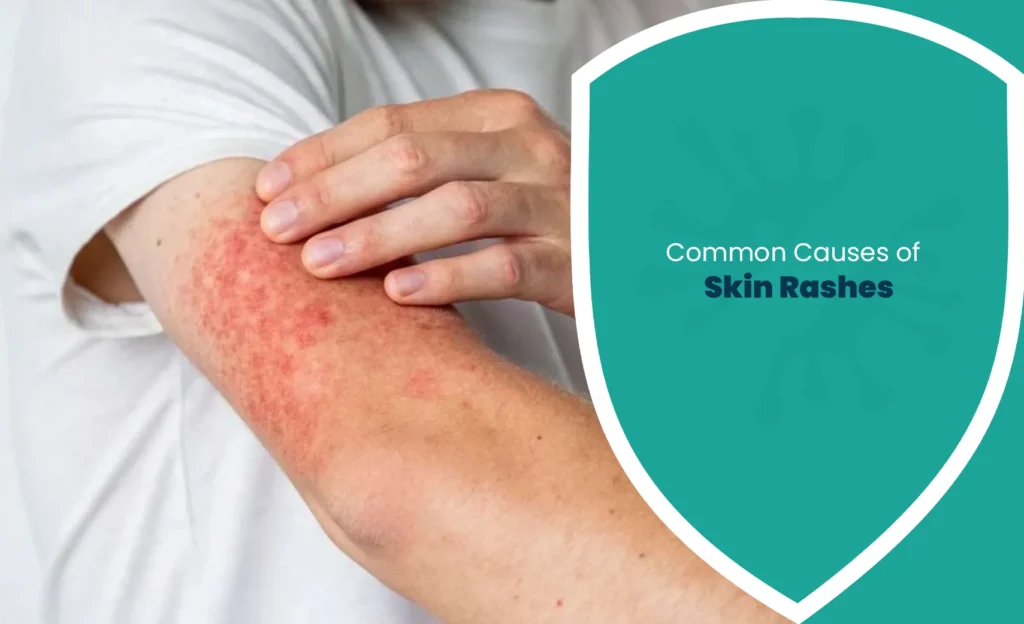
You wake up, glance at your arm, and there it is. A red patch that definitely wasn’t there yesterday.
Table of Contents
ToggleAnnoying. A bit worrying too.
I’ve had this happen more than once, and the first thing I do is Google it, which never really helps. Ten minutes later I’m convinced it’s something rare and awful. So this is my attempt at a saner version. Nothing fancy. Just what tends to cause skin rashes, and when it’s actually worth calling someone.
Okay, so what even is a rash?
Basically, your skin is reacting to something. That’s the simplest way I can put it.
Something could be outside, like a plant, a new soap, or a bug bite. Or inside, like an infection, a medicine, or your immune system being weird. Sometimes it’s a bit of both, and nobody can tell.
A rash can be red, bumpy, flaky, blistery, dry, weepy, itchy, painful, or none of those. Not helpful, I know. That’s exactly why the common causes of skin rashes are harder to sort out than they sound.
And the look of it doesn’t always settle anything. Two totally different problems can look almost the same. Doctors get fooled by this too, which is oddly comforting.

The boring everyday stuff, mostly
Let’s start with what’s most likely, because it’s usually not dramatic.
Contact dermatitis. Fancy name, simple idea. Something touched your skin, and your skin didn’t like it. A new laundry detergent, a perfume, the nickel in a watch strap or a jeans button, latex gloves, and washing your hands forty times a day. Skin irritation causes are often this dull, and people miss them because they’re hunting for something bigger.
There are two kinds, sort of. Irritant, where the thing just damages the skin (harsh soap, say). And allergic, where your immune system decides it hates one specific thing. The allergic kind can show up a day or two later, which makes tracking it down a pain.
Poison ivy is the classic in the US. In the UK, it’s more nettles or giant hogweed. Different plants, similar misery.
Try to remember what changed in the last few days. New product? New job? New dog? It’s annoying detective work, but it pays off.
Bug bites belong in here too. Fleas, bed bugs, and mosquitoes. They tend to show up in clusters or little lines, often on the bits of you that were uncovered overnight. If you’ve got bites and no memory of getting bitten, that’s a clue on its own.
Allergies and hives, the fast ones
Hives are a different thing. They come up quick, raised welts, usually itchy, and they wander. One spot fades, and another pops up somewhere else.
A sudden skin rash like that after eating something, after a new medicine, or after a bee sting, is often an allergic reaction. Sometimes it’s a virus instead. Sometimes nobody ever finds out why, which is frustrating but very common.
One thing I’ll say clearly, though. If the rash comes with swelling of the lips, tongue, or face, or wheezing, or your throat feels tight, that’s not a wait-and-see situation. Get emergency help. 911 in the US, 999 in the UK. Don’t overthink it.
Eczema, the one that never really leaves
Eczema (atopic dermatitis, if you want the proper name) is one of the more common skin conditions out there, especially in kids, though plenty of adults deal with it for years.
It tends to be dry, patchy, and itchy. Behind the knees, inside the elbows, and sometimes on the hands. And the itch is the real problem, because scratching makes it worse, then it itches more, then you scratch. You know the loop.
That itchy skin rash can flare with cold weather, stress, sweat, certain fabrics, or nothing you can put your finger on.
Underneath, it’s basically skin inflammation plus a weaker barrier, so moisture escapes and irritants get in more easily. Which is why boring stuff like a thick, fragrance-free cream helps more than people expect.
Psoriasis gets mixed up with it a lot. Psoriasis is usually thicker, with silvery scaly patches, often on the elbows, knees, and scalp. Different animal. From a distance, though, it’s easy to confuse.
Heat, sweat, and clothes that don’t breathe
Heat rash is real and kind of underrated. Sweat gets trapped, tiny bumps appear, and it feels prickly. Babies get it, but so do adults in humid weather, or under a heavy backpack strap, or after a long run in synthetic gear.
It usually clears by itself if you cool down and stop rubbing. Loose cotton. A fan. A cool shower. Not glamorous advice, but it works.
Sun can do it too. Some people get a bumpy, itchy reaction on the first proper sunny days of the year, then it settles as the skin adjusts. Weird, but common.
Infections, where I’d slow down a bit
This is where things get less simple.
Fungal ones first. Ringworm (nothing to do with worms, annoyingly), athlete’s foot, and jock itch. Usually a ring-shaped patch with a scaly edge, and itchy. These need antifungal cream, not steroid cream, and the wrong one can make things worse. Worth checking before you grab whatever’s in the cupboard.
Bacterial ones next. Impetigo shows up as crusty, honey-colored patches, common in children. Cellulitis is deeper: red, warm, swollen, and tender, and it can spread. Cellulitis especially needs a doctor, same day if possible.
Some bacterial infections are treated with antibiotics, and Azax 500 mg (azithromycin) is one name that comes up. But it’s prescription-only, it’s only for bacterial infections, and it does nothing for viral, allergic, or fungal problems. Doctors pick an antibiotic based on the germ and your history, not just because there’s a rash. Taking one you don’t need adds risk and no benefit.
Then viral ones. Chickenpox, measles, shingles, hand, foot, and mouth. Shingles is typically a painful strip of blisters on one side of the body, and earlier treatment helps, so if you suspect it, call soon. Measles has been circulating again in both countries, so a rash with fever, cough, and red eyes shouldn’t be brushed off.
Medicines can cause them too
Not what people expect, but yes. Antibiotics, painkillers, seizure medicines, and plenty of others can cause a drug rash. Even a medicine you’ve taken before.
So if you start Azax 500 mg or anything similar and a rash appears, call your doctor or pharmacist that same day. Don’t just push through. Most reactions are mild, but a few are serious, and the serious ones often begin with rash symptoms plus fever, mouth sores, or peeling skin.
Don’t stop other prescribed medicines on your own, though. Ring first.
Stress and the odd ones
Stress doesn’t make most rashes out of nothing. It can make eczema, hives, and psoriasis flare, though. People roll their eyes at that, and yet it’s real.
Scabies. Tiny mites, intense itch, worse at night, often between the fingers. Spreads through close contact. Easy to miss and easy to feel embarrassed about, which is silly, honestly.
Lupus can cause a butterfly-shaped rash over the cheeks and nose. Rare. I mention it because if a rash won’t go away and you’re also tired all the time with sore joints, keep pushing for answers.
Not everyone’s rash looks the same
Something I didn’t know for ages. Most pictures online show redness on lighter skin. On darker skin, the same rash can look purple, brown, grey, or just darker than the skin around it. Redness can be really hard to see.
So if you’re comparing your skin to a photo and thinking it doesn’t match, that might be why. Feel it as well as look at it. Warmth, bumps, rough texture, tenderness. Those count.
A rough gut check before you panic
Not a rule, just how I’d think about it.
Is it itchy or painful? Itchy leans toward allergy, eczema, fungus, and scabies. Painful, leaning toward infection or shingles. Is it spreading fast? Any fever? Did anything change lately, like soap, food, medicine, plants, or a new gym?
There are honestly dozens of types of skin rashes, and I’m not going to pretend I can list them all. Most skin rashes are harmless and settle in a week or two.
A red skin rash that’s warm, spreading, and comes with a fever deserves a same-day call. A rash on skin that’s dry, mild, and steady for days is probably fine to watch, keep moist, and leave alone.
Take photos. One a day. Skin rashes change fast, and by Thursday you’ll have forgotten what it looked like on Tuesday.
Oh, and the glass test. Press a clear glass firmly on the spots. If they don’t fade under it, especially with a fever or feeling really unwell, get emergency help. It can point to something serious like meningitis or sepsis.
When I’d stop guessing
Fever. Blisters. Sores in the mouth. Pain that seems out of proportion. Face swelling. A baby with a rash and a temperature. Anything that spreads over hours instead of days.
Or just, it’s been a week or two, and nothing’s improving. Go.
In the UK, a pharmacist is a decent first stop for mild stuff, and NHS 111 if you’re unsure. In the US, an urgent care clinic or a call to your regular doctor’s nurse line does the job.
Also, if you keep getting recurring skin rashes, get a proper diagnosis rather than guessing forever. Patch testing, a skin swab, a blood test, a dermatologist. Sometimes the answer is simple. Sometimes not.
Anyway
I know skin rash causes are a huge topic, and I’ve skipped loads. That’s fine. Nobody needs to know all of it.
Watch it, keep it clean, don’t scratch (I know), and don’t self-treat with leftover pills from the bathroom drawer. If something feels off, trust that.
FAQs
- Are skin rashes contagious?
Depends. Eczema and hives aren’t, but ringworm, scabies, impetigo, and viral rashes can be.
- When should I see a doctor?
If it spreads fast, comes with fever, blisters, or pain, or hasn’t improved after a week or two.
- Can stress cause a rash?
It can trigger flares of hives, eczema and psoriasis, yes.
- Is hydrocortisone cream okay to use?
A mild one for a few days on an itchy, uninfected patch is usually fine. Check first if you’re unsure what it is.
- Do antibiotics clear every rash?
No. They only work on bacterial infections, and most rashes aren’t caused by bacteria.
Lorem ipsum dolor sit amet, consectetur adipiscing elit. Ut elit tellus, luctus nec ullamcorper mattis, pulvinar dapibus leo.