Most people in the US or UK hear the word malaria and think of somewhere far off. A jungle, maybe. A documentary with a sad voiceover.
Table of Contents
ToggleAnd honestly, that’s fair. For most of us it is far off.
Until it isn’t. Someone books two weeks in Ghana to see family, or a safari in Tanzania, skips the tablets because they “feel fine,” and three weeks after landing back home they’re shivering under a duvet in July. It happens more than you’d think.
So let’s just talk about it. What it is, how you get it, and what to watch for. I’m going to lay it out the way I’d explain it to a friend, and it might wander a bit.
So what actually is this thing?
Malaria is an illness caused by a tiny parasite that lives in your liver first and then in your red blood cells. That’s the short version.
The parasite has a proper name. It’s a Plasmodium parasite, and five species can infect people. You don’t catch it from a cough or a hug or a shared cup. You catch it from a mosquito. That’s more or less the whole story.
Doctors call it a mosquito-borne infection, which just means the mosquito does the delivering. A very small, very annoying courier.
The numbers are big, though. Malaria still kills around 600,000 people a year, according to the World Health Organization, out of roughly 260 million cases. Most of those deaths are young children in sub-Saharan Africa. I read that figure and had to sit for a second.
In the US, the CDC counts about 2,000 cases a year. The UK is in a similar range, somewhere between 1,500 and 2,000. Almost all of them are people who travelled.
The bite, and what happens right after
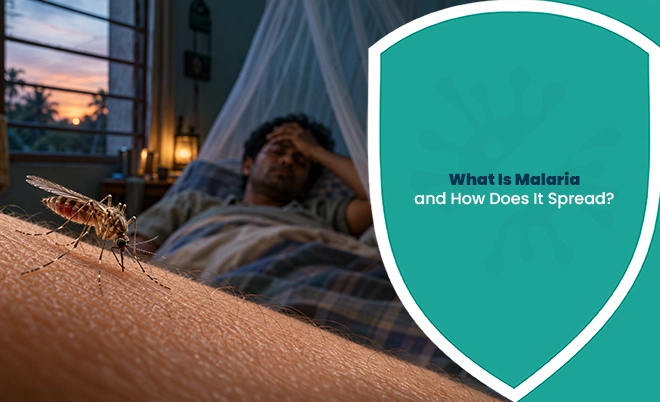
Only certain mosquitoes carry it. The Anopheles mosquitoes, and only the females, because they need blood to make eggs. Males don’t bother anyone.
Here’s the loop. A female bites someone who already has the parasite in their blood. She picks some up. A week or two later, once it has developed inside her, she bites somebody else. One infected mosquito bite is enough. Just one.
They mostly feed from dusk through the night. So it’s the evening on the patio, the walk back to the hotel at 9 pm, that matters more than lunch by the pool.
I always assumed it was a daytime thing. It isn’t, mostly.
Okay, but how does it really get around?
People ask how malaria spreads and expect something dramatic. It’s not. It’s the bite. Nearly always.
There are a few oddball routes. A mother can pass it to her baby during pregnancy or birth. Blood transfusions, organ transplants, and shared needles can do it too. All rare, and in the US and UK donated blood gets screened, so rarer still. But real, so I’m mentioning it.
What malaria can’t do is jump from one person to the next just because they’re in the same room. Someone sick in your house isn’t going to hand it to you. A mosquito has to be in the middle. Well, mostly. See the rare stuff above. I know, I contradicted myself.
The whole parasite transmission chain depends on that one flying middleman, which is why nets and mosquito control have saved so many lives.
Quick side note, because people mix these up. Dengue, Zika, West Nile, and yellow fever are other mosquito-borne diseases, but each has its own germ and its own pattern. And a mosquito bite infection, the red, swollen, warm kind where you scratched it and bacteria got in, is a totally separate thing. Bacteria, not a blood parasite.
What it does once it’s inside you
The parasite life cycle is weirder than you’d expect.
It goes in through the bite and heads straight for the liver. It hides there for a while, multiplying quietly. You feel nothing. Then it breaks out into the bloodstream and invades red blood cells, multiplies again, and the cells burst. That’s when you start feeling awful. Then the new ones go and invade more red cells. Round and round.
Some of them turn into a form the next mosquito can pick up. Then the loop starts again.
Most of the damage malaria causes comes down to red blood cells getting wrecked. That’s why anemia and bone-deep tiredness come along with it, and why severe cases can hit the brain, kidneys, and lungs.
It’s a classic tropical infectious disease. Warm, wet places with standing water are where it thrives, which is why sub-Saharan Africa, South Asia, and parts of Latin America carry so much of it. Kids under five and pregnant women get hit hardest.
The different kinds
Five types of malaria infect humans. Falciparum, vivax, ovale, knowlesi, and one more that’s milder but can linger for years.
Falciparum is the dangerous one. It causes most of the deaths. Vivax and ovale are sneaky, because they can rest in the liver and flare up months later, when you thought you were done. Knowlesi comes from monkeys in Southeast Asia and can turn serious fast.
Which one you have changes the treatment. So the lab work matters, and so does telling the doctor exactly where you’ve been.
The symptoms are annoyingly vague
Early malaria symptoms look like the flu. Or a bad hangover. Or a stomach bug. That’s the whole problem.
The classic pattern is fever and chills, sometimes shaking so hard your teeth rattle, then a drenching sweat as it breaks. Add a headache, muscle aches, feeling completely wiped out, and nausea, maybe vomiting.
Timing is odd too. It usually shows up 7 to 30 days after the bite, but it can be later. Sometimes a lot later.
If you’ve been somewhere with malaria and you get a fever, even months afterwards, say so out loud to whoever is treating you. Say where you went. Get a blood test the same day if you can. A rapid test or a blood smear can tell you fairly quickly.
And the emergency signs: confusion, seizures, trouble breathing, yellow skin, very dark urine, and extreme weakness. Don’t waste those. Go.
Why travelers get caught out
This bit bugs me a little.
Most cases in the US and UK come from people visiting friends and family abroad. They grew up somewhere with it, or their parents did, and they figure they’re used to it. But that protection fades once you’ve lived away for a few years. Then they skip the tablets, or the trip is “only ten days.”
Doctors see this pattern over and over. It’s not carelessness, really. It’s just human.
Prevention is boring, but it works
Malaria prevention isn’t glamorous. Sleep under a treated net. Use a repellent with DEET or picaridin. Wear long sleeves at dusk, use screens or air conditioning, and don’t leave standing water around. Then there’s the preventive medication, and that’s where it gets tricky.
HCQS 400 Mg comes up a lot in searches. It’s hydroxychloroquine, an older drug that has been used against malaria, both to prevent it and to treat it. The catch is a big one. In lots of the world, especially where falciparum is common, the parasite has become resistant, so it simply doesn’t work there. It can still make sense in the smaller number of regions where the parasite stays sensitive.
So HCQS 400 Mg is not something to grab off a website and start taking. Your dose, when to start, and whether it’s even the right drug for where you’re headed are a doctor’s call. It’s also used for lupus and rheumatoid arthritis, and it isn’t right for everyone. Heart rhythm problems, eye conditions, and other medicines all need to be on the table first.
Other drugs exist for places where it won’t work, like atovaquone-proguanil, doxycycline, and mefloquine. Each has its own downsides.
In the US, a travel medicine clinic is the place to go. In the UK, your GP practice or a travel health pharmacy. Ideally four to six weeks before you leave, because some tablets need to start early. Not at the airport.
If it happens anyway
It’s treatable. That’s the part people forget.
Caught early, the right drugs clear it, and for the serious kind, hospital care is often needed, sometimes IV medication. What makes it dangerous is the delay. Days of “It’s probably just the flu.”
Anyway. That’s about where I’ve landed. It’s preventable, it’s curable when caught early, and it’s very easy to ignore until it isn’t. If you’re travelling, sort out the plan before you fly.
FAQs
- Can it spread from person to person?
Not through normal contact. Rare exceptions are pregnancy, blood transfusion, and shared needles.
- How long until symptoms start?
Usually 7 to 30 days after the bite, though some types can take months.
- Is malaria curable?
Yes, if it’s caught early and treated with the right drugs. Delays make it much more dangerous.
- Can malaria be cured without medicine?
No, malaria cannot be cured without medicine.
- Can I get it in the US or UK?
Almost all cases come from travel. Local spread in either country is extremely rare.