Bacteria have been around for something like 3.5 billion years, give or take, and somehow the thing that keeps them in check isn’t some fancy chemical or a human invention. It’s a virus. A tiny one. Smaller than the bacteria it’s attacking, which honestly sounds impossible until you actually look at the size difference on paper. These are bacteriophages, and once you start reading about them it’s hard to stop, because the whole thing is kind of unsettling in a cool way.
So what is a bacteriophage? The short version-it’s a virus that infects bacteria, nothing else, just bacteria. Not humans, not plants, not your dog. Just bacteria. The word itself breaks down into “bacteria” plus “phage,” and phage comes from a Greek word meaning “to devour.” So literally, bacteria-eater. Which is a pretty accurate name once you see what these things actually do to a cell.

They were discovered way back, early 1900s, by a couple of scientists working somewhat independently-Frederick Twort and Félix d’Herelle, though d’Herelle usually gets more of the credit because he’s the one who actually pushed forward using them as a treatment. They called it Phage therapy. Then antibiotics came along a few decades later and phages sort of got pushed to the side, at least in the West. Countries like Georgia and Russia kept researching them though, and now with antibiotic resistance becoming this massive global problem, everyone’s suddenly remembering phages exist and maybe we should have kept working on those.
Is a bacteriophage a virus?
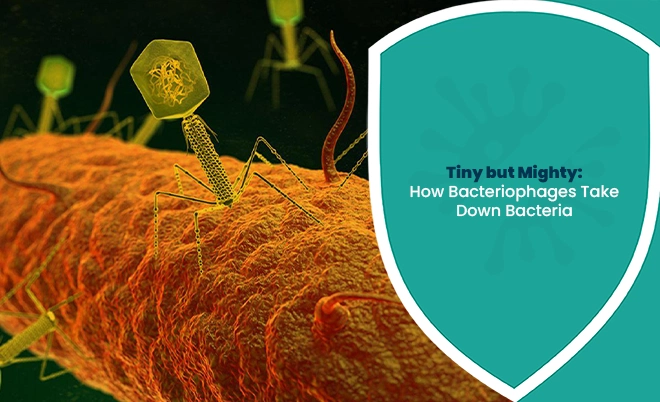
Yes. A bacteriophage is a virus, full stop. But I get why people ask this because phages don’t really look like what most of us picture when we think “virus.” No spiky ball shape like the coronavirus illustrations everyone’s seen a thousand times by now. Phages, at least the classic ones, look almost mechanical. Like tiny lunar landers or something out of a sci-fi movie. Icosahedral head, a tail, sometimes tail fibers that look like little legs. It’s weird. Nature didn’t need to make them that specific shape but here we are.
And because they’re viruses, they follow the same basic virus rule-they can’t reproduce on their own. They need a host cell to hijack. For phages, that host is always a bacterium. That’s the whole deal.
What do bacteriophages infect anyway?
Just bacteria. I keep saying this but it bears repeating because people genuinely get confused and think maybe phages could infect us too since, well, viruses infect us all the time. But phages are picky. Painfully picky actually. A single phage type usually only infects one species of bacteria, sometimes even just certain strains within that species. It’s not like they’re roaming around infecting whatever’s nearby.
This pickiness is actually one of the reasons researchers are excited about phage therapy again because unlike a broad spectrum antibiotic that wipes out good and bad bacteria in your gut indiscriminately, a phage can be aimed at exactly the bad guy and leave everything else alone. In theory anyway. Real-world application gets messier, matching the right phage to the right infection takes time and lab work, but the concept is solid.
Can bacteriophages infect human cells?
No. And this is worth sitting on for a second because it surprises people. Human cells and bacterial cells are structurally different-different receptors, different membrane setup, totally different biology on a cellular level. Phages have evolved receptors on their tail fibers that only recognize specific proteins or sugars on bacterial cell walls. Human cells don’t have those same markers. So a phage bumping into a human cell is kind of like a key that doesn’t fit any lock in your house; it just doesn’t do anything.
This is part of why phage therapy is considered relatively safe compared to some other treatments. The phages aren’t interested in us. We’re not on the menu, so to speak.
What is inside a bacteriophage?
Inside the protein shell there is the capsid and in it there’s genetic material. Could be DNA or RNA depending on the phage, though DNA phages are the more commonly studied ones, at least the well-known ones like T4. That genetic material is tightly packed inside the head of the phage, coiled up under a surprising amount of pressure actually, like a spring ready to shoot forward.
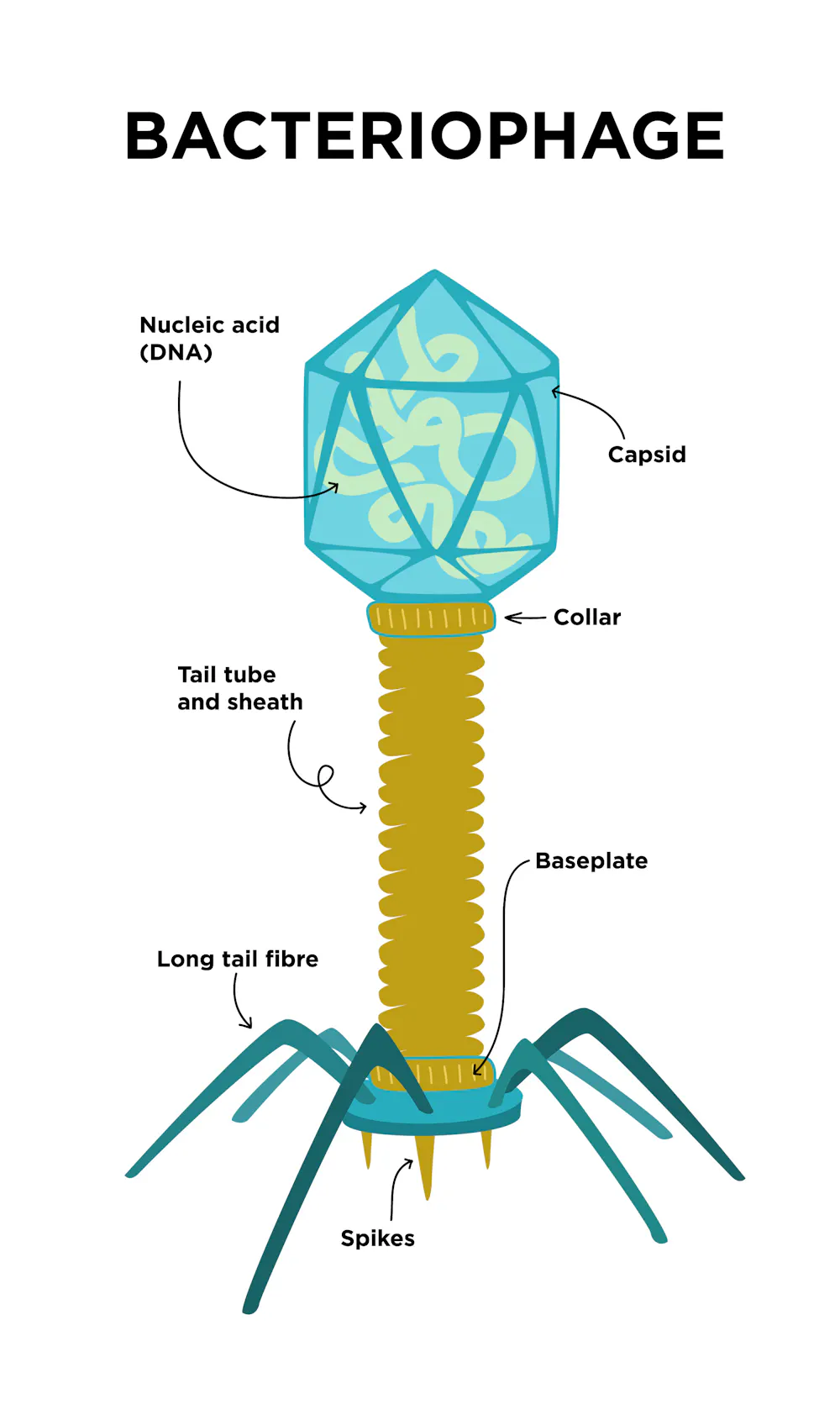
That’s basically it. No extra organelles, no metabolic machinery, nothing like that. Just genetic instructions wrapped in protein armor. Some phages also carry a few enzymes packed in with the genome to help kickstart infection once they’re inside the host, but the core of it is: protein coat outside, genetic code inside.
How does a bacteriophage destroy a bacterial cell?
A phage lands on a bacterium using those tail fibers to find just the right receptor and it doesn’t even go inside itself. Just the genetic material gets injected. The protein shell stays outside, kind of like a syringe that leaves its casing behind after the injection. Once that DNA is inside the bacterial cell, it basically takes over. Hijacks the cell’s own machinery and forces it to start making copies of the phage-new capsids, new genetic material, all of it, using the bacterium’s own resources against itself.
Eventually the cell is so packed full of newly made phage particles that it just can’t hold together anymore. It bursts. Lysis, that’s the term. The cell wall ruptures and dozens, sometimes hundreds of new phage particles spill out, ready to go find new bacteria to repeat the whole process on. This is called the lytic cycle, and it’s brutal and fast and honestly kind of beautiful in a horror-movie sort of way.
But not all phages kill right away
Now here’s where it gets a bit more complicated, and this actually answers something people ask a lot, “How can bacteriophage DNA be spread from cell to cell without causing cell death?.
“ Because not every phage goes straight for destruction. Some take what’s called the lysogenic path instead.
In this version, the phage injects its DNA like usual, but instead of immediately hijacking the cell to make more phages, the DNA integrates itself into the bacterial chromosome. It just sits there, quiet, called a prophage at this stage. And then when the bacterial cell divides i.e. normal reproduction, the phage DNA gets copied right along with the bacterial DNA. So it spreads to daughter cells without killing anything. The bacteria don’t even necessarily know they’re carrying viral DNA passengers along for the ride.
This can go on for generations honestly, quietly riding along, until something triggers it-stress, UV light, certain chemicals and then the prophage can “wake up,” excise itself from the chromosome, and switch back into that lytic, cell-bursting mode. It’s kind of a sleeper agent situation if you want to think of it that way. Not the most scientific way to put it but it gets the point across.
Why does any of this matter right now?
Antibiotic resistance isn’t some future problem, it’s already here, already killing people, and it’s only getting worse as bacteria keep adapting faster than we can develop new drugs. Phages offer this alternative path that doesn’t rely on chemistry so much as it relies on evolution itself using one organism’s natural predator against it. There have been case studies, some pretty dramatic ones actually, where patients with bacterial infections that got worse or didn’t respond to any antibiotic were treated with a customized phage cocktail and recovered. It’s not mainstream medicine yet, at least not in most Western countries, but the research is picking up speed again.
There’s also research into using phages in food safety, agriculture, even wastewater treatment. Basically anywhere bacteria cause problems, someone somewhere is probably testing whether a phage could help. It’s a weirdly versatile tool for something so microscopic and single-purpose.
FAQs
1. What is a bacteriophage in simple terms?
Bacteriophage is a virus that only infects and kills bacteria.
2. Is a bacteriophage a virus?
Yes, it’s a sort of virus, but one that only attacks bacteria.
3. How does a bacteriophage kill a bacterial cell?
Bacteriophage injects its DNA and hijacks the cell to make copies of itself later bursting the cell open.
4. Do bacteriophages infect human cells?
No, human cells lack the receptors phages required to attach and infect.
5. Is bacteriophage a virus?
Yes. Bacteriophage is a type of virus.