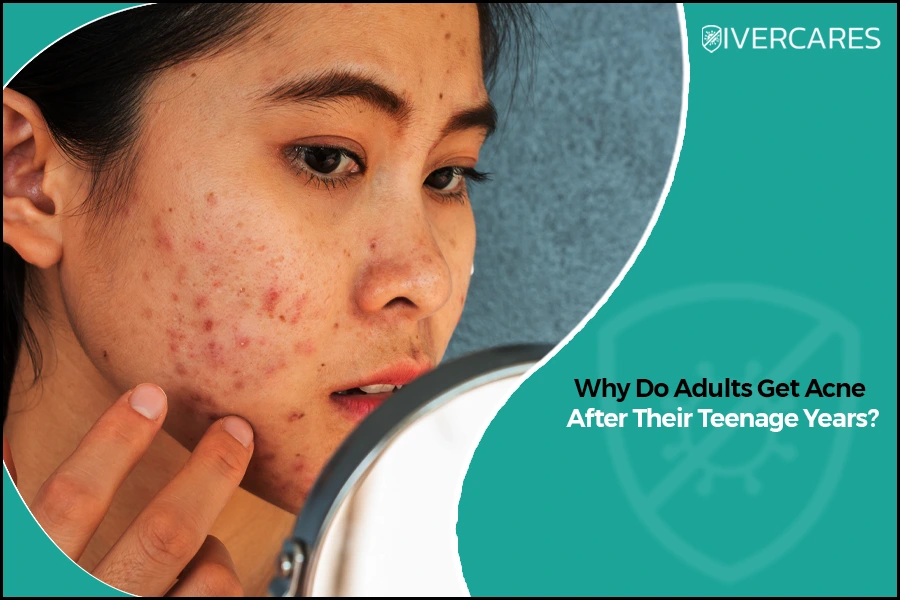
I got my first proper jawline pimple at 31. Deep, sore, the kind that sits under the skin and never quite comes to a head.I remember standing in front of the bathroom mirror, thinking, hang on, I already did this. Fifteen to nineteen. Done. Where’s my refund?Turns out loads of people are in the same boat, so I went digging. This is the slightly scruffy version of what I found.
Wait, this is actually common?
Annoyingly, yes. Surveys put the number of adults with breakouts at somewhere between a quarter and a half, depending on the age group and who’s counting. Women seem to get it more than men. I wouldn’t hold myself to the exact figures, because they bounce around a lot.For plenty of people, the teenage stuff settles by the early twenties. For some it never really stops. And for others it disappears for ten years and then turns up again like an ex who’s “just in the area.”That last group is where the question I kept typing into Google came from: basically, why acne returns in adulthood.Short answer: it’s usually several things at once. The long answer is below, and it wanders.The boring mechanics first
A pore gets blocked with oil and dead skin cells. The bacteria that live on everyone’s skin like it in there. Your immune system gets annoyed. Redness, swelling, a spot.Same basic process as when you were fifteen. Clogged pores in adults are still the starting point. It’s just that the reasons they clog can be different now.The spots can look different too. Fewer blackheads, more of those deep, tender lumps. Jaw, chin, and sides of the face. Though not always. I know people who get it mostly on their back.
Hormones, because of course
If I had to pick one culprit, it would be this. Although I hate picking just one.Androgens are hormones that tell your oil glands to make more oil. Everyone has them, women included. When levels shift, or your skin becomes more sensitive to them, oil goes up, and pores clog. That’s the idea behind hormonal changes and acne turning up in your twenties, thirties and beyond.The triggers are the usual life stuff. Periods, with a flare a week or so beforehand. Pregnancy and the months after. Coming off the contraceptive pill. Perimenopause.Acne around the jawline and chin is the classic pattern, especially if it’s deep and sore and keeps coming back in the same spots every month. Classic, I said. Not guaranteed.Then there’s PCOS, or polycystic ovary syndrome. If your breakouts come with irregular periods, extra hair on the face or body, or thinning on top of the head, go and talk to a doctor. It’s common, it’s treatable, and it gets missed a lot.Men aren’t off the hook either. Anabolic steroids and testosterone products are well-known triggers. Some people blame protein powders, but that evidence is weaker.Stress, which I resent
Stress and adult acne have a long history together. Stress raises cortisol, which may nudge oil production and inflammation up. Some studies point that way, but I’d call the evidence mixed, not airtight.What I know from experience is that bad sleep plus a deadline week makes my forehead look like a dot-to-dot puzzle.Stressed people pick, too. I pick. Picking turns a small bump into a week-long event, and sometimes a scar. Hands off. Easier said than done, obviously.Stuff in your bathroom and your kitchen
Heavy foundation, rich creams, hair oils, and pomades that touch your forehead. Some are fine, some aren’t. “Non-comedogenic” on a label is a hint, not a guarantee, since it isn’t tightly regulated.Friction matters too. Shaving, tight helmets, face masks rubbing, your phone pressed against your cheek. Sweat sitting on skin for hours.Some medicines can set off breakouts, including corticosteroids, lithium, and certain anti-seizure drugs. Don’t stop anything on your own, though. Ask whoever prescribed it.Diet gets everybody shouting. There’s some evidence linking high-sugar, high-glycemic diets, and maybe skimmed milk, to breakouts in some people. It’s far from settled, and it varies from person to person. I’m not going to tell you to give up cheese. I couldn’t do it myself.Genetics matter as well. If your parents had it, you’re more likely to. Can’t fix that. You can only blame them.Twenties, thirties, and later
In your twenties, it often feels like leftover teen skin, oily and spotty in several places at once. Adult acne in your 20s, 30s, and 40s tends to sit lower on the face, along the jaw and chin, and lean towards those deep, tender lumps. That’s from what I’ve read, anyway.Doctors sometimes split it into two types. Persistent adult acne usually means it carried on from your teens and never really left. Late-onset means it showed up fresh after 25 or so.Either way, it’s real, and it’s not a hygiene problem. People assume you’re not washing enough. Mostly the opposite is true, because over-washing makes it worse.A routine that doesn’t fight your face
A skincare routine for adult acne should be dull. Gentle cleanser, once or twice a day at most. Moisturiser. Sunscreen every morning, because lots of treatments make your skin more sun-sensitive, and the sun darkens the marks left behind.Then, if you want actives, there are a few with decent evidence. Benzoyl peroxide. Salicylic acid. Azelaic acid. Adapalene, a retinoid, you can buy over the counter at pharmacies in both the US and the UK.Add one at a time. Start slowly. Scrubbing, harsh toners, and five new products at once will just leave you red and flaky and still spotty.Give anything at least six to twelve weeks before deciding it doesn’t work. I never do this. I give up at week two and buy something else.Acne-prone skin also gets dry from treatment, so moisturizer isn’t optional. I skipped it for a month and regretted it.Preventing adult breakouts completely probably isn’t realistic. Fewer, smaller, and less angry is a fair goal.The prescription route
If the shop-bought stuff stalls, a doctor might suggest a prescription retinoid. Tretinoin Cream Tretiheal 0.025% is one example you might come across. I’m not sure how that particular brand is licensed or sold in your country, since brand names and strengths vary, so check with your pharmacist.Tretinoin in general is prescription-only in both the US and the UK. It speeds up how quickly skin cells turn over, which helps keep pores clear. The 0.025% strength is on the gentler end, which is why it’s a common place to start.The first few weeks can be rough. Dryness, peeling, redness, stinging. Skin sometimes looks worse before it gets better, and that can last a month or two. Real results often take two to three months, which feels like forever.Usually people are told to use a pea-sized amount at night on dry skin, a couple of times a week to begin with, and to build up slowly. Keep it away from eyes, mouth, and the creases of the nose. Wear sunscreen daily. Don’t pile harsh exfoliants on top.And it’s not for pregnancy, or for trying to conceive. Tell your doctor if there’s any chance of that. So if a doctor does suggest Tretinoin Cream Tretiheal 0.025%, ask how often to start, how long to wait before judging it, and what to do if your skin gets very sore.Other options exist. Topical antibiotics paired with benzoyl peroxide, for a limited time. Hormonal treatments for some women, like certain contraceptive pills or spironolactone. For severe or scarring cases, isotretinoin comes with strict monitoring and pregnancy precautions. A doctor can sort out which one fits.When to get proper help
Honestly, sooner than most of us do. If a couple of months of sensible over-the-counter care hasn’t touched it, that’s reason enough.Dermatologist advice for acne matters even more if you’re getting deep, painful cysts, if you’re seeing scars or dark marks, or if it’s flattening your mood. That last one is real. Spots can wreck your confidence, and asking for help with that isn’t vain.In the UK, your GP is the first stop. In the US, it might be a primary care doctor or a dermatologist directly, and telehealth appointments can be quicker.Sudden, severe breakouts, or breakouts alongside irregular periods and extra hair growth, are worth getting checked rather than waiting it out.So, my jawline
Mine took about three months of boring consistency to calm down. Not gone. Calmer. I still get the odd one before a period, and I still swear at the mirror.What bugs me is that I spent years assuming I’d done something wrong. Wrong cleanser, wrong diet, wrong everything. Mostly I hadn’t. My skin just did its thing.If yours is doing that too, you’re not behind on anything. You’re just a grown-up with a pimple.FAQs
- Why do adults get acne?
- Is adult acne always hormonal?
- How long does tretinoin take to work?
- Can I use tretinoin if I’m pregnant?
- When should I see a doctor about breakouts?