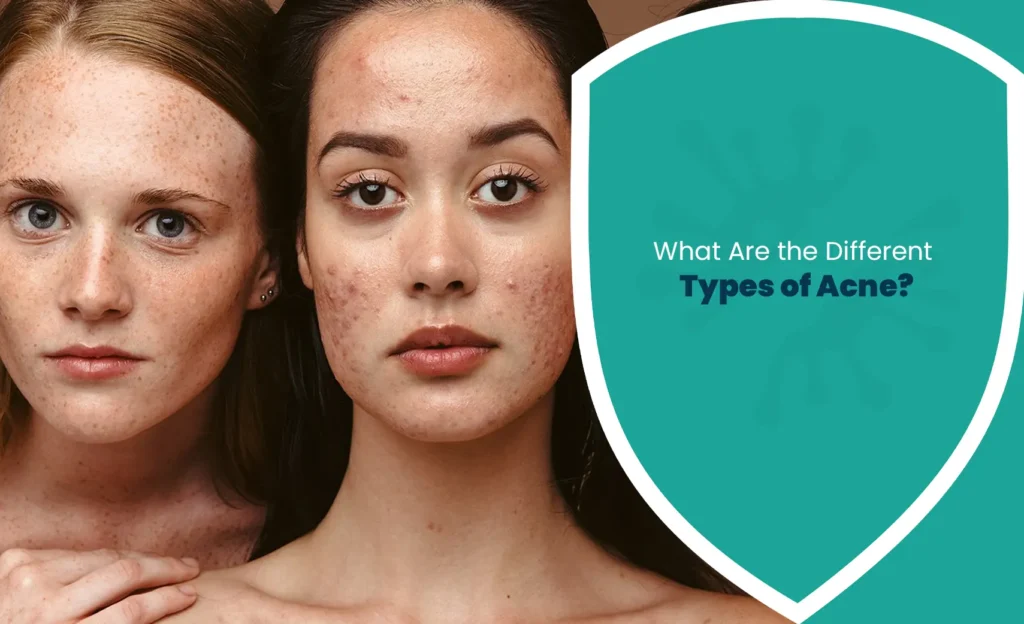
Okay, so I’ve been meaning to write this for a while because every time someone says, “I have acne,” I always want to ask, “Okay, but which kind? Because there isn’t just one. There are types of acne, plural, and they don’t all behave the same or respond to the same stuff.
Table of Contents
ToggleI remember thinking as a teenager that a pimple was a pimple. Turns out that’s not really true there are different types of pimples hiding under that one word, and they don’t behave alike at all. Some are just clogged pores sitting there doing nothing dramatic. Others are red, angry, under-the-skin lumps that hurt when you touch them. Totally different animals wearing the same “acne” label.
The boring clogged-pore kind (but it’s actually most common)
So the first bucket is comedonal acne. This is basically your blackhead and whitehead pores that got clogged with oil and dead skin and just sat there. No real inflammation, no redness, just… bumps.
Dermatologists usually call this non-inflammatory acne, which sounds very clinical, but really it just means nothing is swollen or infected yet. It’s the mild acne version, honestly, at least compared to what comes later.
A blackhead is open at the top, so the trapped stuff oxidizes and turns dark. A whitehead is closed, stays under the skin, and stays pale. Same clog, different lid situation basically.
I feel like a lot of people don’t even count this as “real” acne, which is kind of unfair to the pores involved.

Then there’s the angry stuff
This is where the inflamed, swollen stuff comes in, and this is the category most people are actually annoyed about when they say “My skin is breaking out.”
Papules and pustules fall here. A papule is that small, firm, reddish bump, no pus, just inflamed. A pustule is basically the same thing except now there’s pus sitting in it, with a white or yellow tip, the kind you probably shouldn’t pop but will anyway.
This tends to be what people mean by moderate acne. Not the mildest, not the worst, just annoyingly persistent and visible.
Honestly, I think this is where most skincare routines either succeed or completely fall apart, because people start over-treating and irritating things further.
The ones that actually hurt
Okay, this next part is the one I always feel bad writing about because it’s genuinely rough for people dealing with it.
Nodular acne and cysts sit at the deeper, more severe end. Nodules are hard, painful lumps way under the skin they don’t really come to a head like a normal pimple. Cysts are similar but softer, filled with pus, and honestly can leave scars if not treated properly.
This is generally labeled severe acne, and it’s not something you just “wash away” with a cleanser. It usually needs an actual dermatologist involved, sometimes prescription treatment, and sometimes a longer plan than people want to hear about.
I keep circling back to this point, but the deeper acne indeed goes, the less it’s about hygiene and the more it’s about oil production, hormones, genetics, bacteria, all of that mixed.
Acne vulgaris, which is just the fancy umbrella term
If you’ve ever seen “acne vulgaris” on a dermatology page and wondered what that even means, it’s just the medical name for common acne, the whole spectrum from blackheads to cysts. Acne vulgaris types basically cover everything I’ve already mentioned above, from comedonal through cystic.
So when people search for types of acne and pimples, they’re usually trying to figure out where their own skin situation lands on this spectrum. Mild? Moderate? Something scarier?
Why do these types of acne even happen
In the short version, oil glands overproduce sebum, pores clog, bacteria (specifically C. acnes) get involved, and inflammation kicks in if the body reacts. Hormones play a huge role too, which is why breakouts cluster around puberty, periods, stress, and sometimes even diet for some people, though that part is debated a lot.
Acne causes aren’t identical for everyone, honestly. Someone’s hormonal cyst on the jawline is a completely different mechanism than a teenager’s oily-forehead blackheads, even though both get slapped with the same word.
Okay, but how do you actually tell them apart
This is where people get stuck, understandably. How to identify acne types isn’t always obvious just by looking in a mirror once.
Texture matters: is it flat or raised, hard or soft? Color matters: red, white, skin-toned, and dark. Pain matters: does it hurt when you touch it or not at all? Those three things alone get you pretty far toward knowing what category you’re dealing with.
Common types of acne usually show up together too, which makes it messier. You might have a few blackheads on your nose, some pustules on your chin, and one annoying cyst near your jaw all at the same time. Skin doesn’t really respect neat categories.
Where something like tretinoin fits into all this
A lot of dermatologists lean on topical retinoids for the milder-to-moderate end of things, and this is where something like Tretinoin Cream Tretiheal 0.025% usually comes up. It works by speeding up cell turnover and keeping pores from clogging in the first place, so it’s mostly aimed at comedonal and mild, inflamed acne rather than the deep cystic stuff.
It’s not an overnight fix, which people hate hearing. It can take a few weeks before you even notice a difference, and honestly, the first couple of weeks can make skin look a bit worse before it gets better some peeling, some redness, kind of an adjustment period.
For more severe or cystic cases, retinoids like Tretinoin Cream Tretiheal 0.025% are sometimes used alongside other treatments rather than as the only thing doing the work, because deeper acne usually needs more than a topical alone.
The pimples people confuse with acne but aren’t
I want to point out something small: people mix up different kinds of pimples with things that technically aren’t acne at all. Like folliculitis, or fungal acne (which isn’t even acne, it’s a yeast thing), or just regular clogged pores from sweat. Not everything bumpy on your face is acne vulgaris.
That’s actually one reason dermatologists exist: figuring out which of the types of acne, or which not-acne-at-all thing, you’re actually looking at.
Does it even matter which type you have
I think yes, mostly because treatment differs so much. A benzoyl peroxide wash might do fine for someone with light, inflamed skin. Someone with deep nodules and cysts probably needs oral medication, sometimes isotretinoin, sometimes hormonal treatment if it’s linked to that.
Acne symptoms overlap a lot on the surface, but the underlying severity is what actually decides the treatment path.
Anyway. If there’s one thing to take from all this, acne isn’t one thing; wearing different outfits, it’s genuinely several different processes that just all get grouped under one annoying umbrella word. Knowing where yours falls helps you stop wasting money on the wrong products, which, honestly, most of us have done at some point.
A random side note about picking
I wasn’t going to include this, but it feels wrong not to. Popping stuff, especially the deeper lumps, tends to make things worse, pushes bacteria further into the skin, sometimes causes more inflammation than there was to begin with, and sometimes scars. Everyone knows this, and everyone does it anyway, myself included, so I’m not going to pretend I’m above it.
Also worth saying, skin doesn’t stay in one category forever. A patch of clogged pores can turn inflamed if bacteria gets involved and things get irritated. What starts mild can shift if it’s picked at, or if the wrong product is layered on top, or honestly sometimes just from stress or a bad week of sleep. It’s not always linear, which is annoying, but that’s kind of how skin works.
There’s also the timing thing nobody talks about enough. Some people get hit hardest around their period, some around exams or work stress, and some just randomly for no clear reason at all. Doctors will say hormones, and that’s usually true, but it’s rarely the whole picture diet, sleep, and even the weather can nudge things one way or another for certain people.
I also think people underestimate how much trial and error is normal here. Nobody gets the right routine on the first try. You might spend a few months on something that barely helps, switch products, overcorrect, irritate your skin further, and then finally land on something that actually works. That’s just how it tends to go, unfortunately, and it’s not really a sign you’re doing something wrong.
FAQs
- Is a blackhead the same as a whitehead?
Not exactly one’s an open pore that oxidizes dark, the other stays closed and pale.
- Is cystic acne the worst kind?
It’s generally considered the most severe and the most likely to scar, yes.
- Can tretinoin help with all types of acne?
It helps most with the milder end of the spectrum; deep, cystic cases usually need more than just a topical.
- Why do the types of acne on my face vary by area?
Oil gland density and hormone sensitivity vary by area, so the jawline, forehead, and cheeks often break out differently.
- Do I need a dermatologist to know which type I have?
Not always for mild cases, but for painful lumps or cysts, yes, it’s worth getting checked.