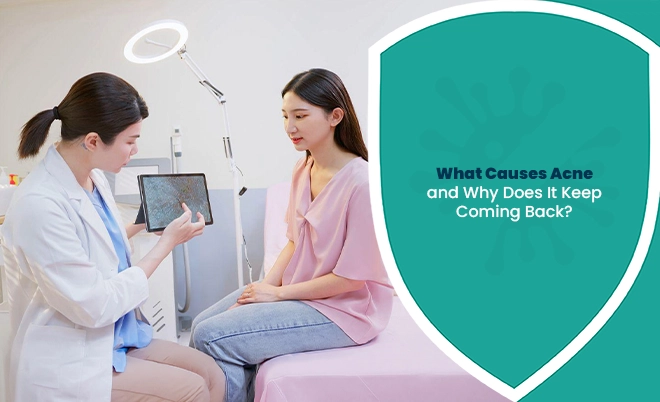
What Causes Acne? Acne is one of those skin problems. Understanding What Causes Acne can help, but it can feel almost unfair. You can wash your face, change your pillowcase, stop touching your skin, and still wake up with a new spot.
Table of Contents
ToggleSo, what causes acne in the first place? Usually, it isn’t one single thing. Acne develops when oil, dead skin cells, bacteria and inflammation start interacting inside the hair follicles. And once you understand that, the reason it can return starts making a little more sense.
Some people get a few spots now and then. Others deal with acne for years, including well into their 20s, 30s or even later.
The frustrating part is that skin can look better for a while and then suddenly flare again.
It usually starts deeper than the spot you can see
Every hair follicle in your skin has a tiny oil gland attached to it. These glands make sebum, an oily substance that helps keep the skin from drying out.
The problem starts when too much sebum mixes with dead skin cells and blocks the opening of the follicle. That creates a clogged pore.
A blocked follicle can turn into a whitehead or blackhead. If inflammation develops, it may become a red, swollen spot or a deeper, more painful blemish.
This is why simply scrubbing harder doesn’t necessarily solve the problem. The process isn’t just sitting on the surface of the skin.
So, what causes acne to keep showing up?
The reasons can be different from person to person, which is part of the reason acne advice can get confusing.
For one person, hormone changes may be the biggest issue. The causes of acne can overlap. For another, certain hair or skincare products may make things worse. Stress, medications, genetics and friction can also play a role.
Then there is the basic biology of the skin. If your oil glands are naturally more active, or your follicles tend to become blocked easily, you may be more likely to develop spots.
That doesn’t mean you did something wrong.
Skin that breaks out easily is not necessarily dirty. In fact, washing too aggressively can irritate the skin and make the whole situation harder to manage.
Hormones can make the pattern frustrating
Hormonal acne is often linked with changes in androgen hormones, which can increase oil production.
This is why some people notice breakouts around puberty. Others may notice a pattern around their menstrual cycle, pregnancy or after stopping or starting certain hormonal medicines.
Adults can develop acne even if their teenage years were mostly clear. This pattern is particularly common around the lower face and jawline, although it can appear elsewhere too.
There is another annoying part. Hormonal changes don’t always happen on a schedule that makes the skin easy to predict.
You might have a clear week, then suddenly several spots appear.
Not every trigger is actually a cause
People often blame chocolate, greasy food, dirty skin, or stress for every breakout. The reality is a bit less straightforward.
Certain foods may affect acne for some people, particularly diets high in refined carbohydrates or certain dairy products, but food is rarely the entire explanation.
Stress can also matter. When you’re stressed, hormonal and inflammatory changes can affect the skin. But saying “stress caused my acne” is usually too simple.
There are many acne triggers, and sometimes a trigger only matters because it adds to a problem that was already developing underneath.
Things such as sweating, tight clothing, helmets, masks, frequent touching, shaving irritation, and heavy cosmetic products can sometimes contribute.
Why blocked pores don’t always stay harmless
Clogged pores may seem like a small cosmetic issue, but they can become inflamed.
Inside the follicle, oil and dead cells provide an environment where Cutibacterium acnes, a type of bacteria normally found on skin, can multiply. Changes in the follicle may cause inflammation as the immune system responds.
That is where inflammatory acne comes in.
The result can be papules, pustules, nodules or cyst-like lesions. The deeper the inflammation, the greater the chance of lingering marks and, in some cases, permanent scarring.
This is one reason squeezing spots is usually a bad idea. It can push inflammation deeper and damage the surrounding skin.
Why does it seem to return in the same places?
This is something people notice a lot.
If the underlying conditions that produced the original breakout are still present, another spot can form in the same general area. The follicle may still be prone to blockage, oil production may still be high, and inflammation may still be active.
So clearing the visible spot isn’t always the same thing as changing the process that produced it.
That is also why breakouts can feel like a never-ending cycle. One spot disappears, another appears, and acne breakouts can feel random.
Sometimes the skin actually has improved. It just hasn’t become completely resistant to new breakouts.
Your daily products can sometimes complicate things
Skincare is another area where things get surprisingly messy.
A product labelled “for oily skin” isn’t automatically right for everyone with acne. Some moisturisers, sunscreens, makeup products, hair oils and styling products can contribute to blocked pores or irritation in certain people.
At the same time, avoiding moisturiser completely isn’t always a good idea.
Acne treatments can dry and irritate the skin, and an overly dry skin barrier can make products harder to tolerate.
For many people, a simple routine works better than having ten different products on the bathroom shelf. A gentle cleanser, suitable moisturiser and non-comedogenic sunscreen are often a reasonable starting point.
Persistent acne deserves a closer look
Long-lasting acne can sometimes point to an underlying issue that needs more attention.
If breakouts are deep, painful, widespread, leaving scars, or suddenly appearing in adulthood, it can be worth speaking with a GP, dermatologist or another qualified healthcare professional.
Acne symptoms can include blackheads, whiteheads, red bumps, pus-filled spots, tender nodules and deeper lesions. The pattern, severity and location can help a clinician work out what type of treatment may be useful.
For women with sudden or persistent adult acne, especially when it occurs alongside irregular periods, excess facial hair or other hormonal changes, a clinician may consider whether an underlying hormonal condition is contributing.
It doesn’t automatically mean there is a serious problem. It just means the bigger picture matters.
There isn’t one perfect treatment
This is probably the most important thing to understand.
A treatment that works beautifully for one person may be too irritating or simply ineffective for someone else.
Topical retinoids such as tretinoin are commonly used to help prevent follicles from becoming blocked and to treat acne. Other treatments may include benzoyl peroxide, topical antibiotics, azelaic acid, hormonal treatments or oral medicines, depending on the person’s situation.
Tretinoin can be especially useful as part of a longer-term approach because it works on the formation of new lesions rather than simply drying out an existing spot.
For people prescribed a stronger formulation, Tretinoin Cream 0.1% Tretiheal should be used according to the directions given by a healthcare professional. A higher strength can be more irritating. Tretinoin Cream 0.1% Tretiheal is a relatively strong formulation, so it may not be suitable for everyone.
Dryness, peeling, redness, stinging and increased sensitivity can happen, especially during the first few weeks.
Using more doesn’t make it work faster. Usually, it just makes the skin angrier.
Why prevention is really about consistency
Acne prevention isn’t about keeping your face perfectly clean or following a complicated 12-step routine.
It is more about keeping the skin routine steady and avoiding the things that repeatedly make your skin worse.
Use a gentle cleanser instead of harsh scrubbing. Avoid picking. Choose products that are less likely to clog pores. Wash after heavy sweating when practical. Give new treatments enough time to work before constantly replacing them.
And don’t expect overnight results.
Many treatments need several weeks before the difference becomes obvious. Stopping every time the skin gets slightly dry can also make it difficult to know whether the treatment would have helped.
There is a balance here. You don’t want to ignore severe irritation, but you also don’t want to abandon a treatment after five days because one new spot appeared.
A few everyday things are easy to overlook
Pillowcases get blamed a lot, but changing them every day isn’t usually the magic answer people hope for.
Still, keeping things that touch your face reasonably clean makes sense.
The same goes for phones, makeup brushes, helmets, chin straps and anything else that repeatedly rubs against the skin.
Hair products are another overlooked factor. If you regularly use oily styling products and notice spots around your forehead or hairline, it may be worth changing the product or keeping it away from the skin.
And then there is picking.
It is tempting. Everyone knows it is tempting.
But squeezing a spot can increase inflammation and raise the risk of marks or scars. Sometimes leaving it alone really is the less dramatic option.
When acne isn’t really about hygiene
This point is worth repeating because acne still carries a weird amount of shame.
Having acne doesn’t mean someone has poor hygiene.
The development of acne involves oil glands, follicular blockage, hormones, inflammation and individual skin biology. Washing your face more often cannot completely switch those processes off.
In fact, excessive cleansing can strip the skin and create irritation without preventing new spots.
So if you’ve tried to “clean” your acne away and it keeps returning, that isn’t necessarily a failure on your part.
The skin is more complicated than that.
The reason it keeps coming back is usually the underlying tendency
So, why acne keeps coming back often comes down to the fact that the skin remains capable of forming new blocked and inflamed follicles.
Even when one breakout clears, oil production, hormone activity and the way your follicles shed skin cells may remain unchanged.
That is why long-term acne management is different from treating a single spot.
You are not just trying to make today’s blemish disappear. You are trying to reduce the chance of tomorrow’s blemish forming.
For someone with acne-prone skin, that may mean a consistent topical routine. For someone with moderate or severe disease, it may mean professional treatment and regular follow-up.
And sometimes the plan needs adjusting.
When should you actually get help?
If your acne is mild and occasional, basic skincare may be enough.
But don’t feel like you have to wait until your skin becomes severely painful before asking for help.
See a healthcare professional if your acne is painful, scarring, widespread, or not improving with appropriate over-the-counter care.
Also get medical advice if acne suddenly appears alongside other unusual symptoms, particularly hormonal changes.
A dermatologist can look at the type of lesions you have, where they occur, how long you’ve had them and what you’ve already tried.
That information can make a surprisingly big difference.
The bigger picture
What causes acne isn’t one neat answer. Many factors cause acne. It is usually a combination of biology, hormones, oil production, follicle blockage, inflammation and individual susceptibility.
And that is also why acne can come and go.
You can improve your skin without being able to guarantee that you will never get another spot. That sounds frustrating, but it is actually a more realistic way to think about it.
Understanding What Causes Acne can make the goal clearer: fewer breakouts, less inflammation, fewer marks and healthier-looking skin over time.
If you are using prescription tretinoin, follow your clinician’s instructions carefully and give your skin time to adjust. If irritation becomes severe, or you are unsure whether the medicine is appropriate for you, speak with a healthcare professional rather than simply increasing or stopping the treatment yourself.
Acne can be stubborn.
It can also be manageable.
The trick is usually figuring out what is driving your particular pattern instead of chasing every new spot as if it appeared for no reason.
FAQs
- What causes acne in adults?
Hormones, excess oil, clogged follicles, genetics, medications and certain skincare products can all contribute.
2. Why does acne keep coming back?
The underlying tendency towards blocked follicles and inflammation can remain even after a breakout clears.
3. Can stress cause acne?
For some people stress can make acne worse, but it’s rarely the sole factor.
4. Is tretinoin useful for recurring acne?
Tretinoin may help prevent the formation of new acne lesions but should be used as directed by a healthcare professional.
5. Should I see a dermatologist for long-term acne?
Yes. Especially if the acne is painful, scarring, widespread or not responding to adequate home treatment.