A friend of mine came back from a beach holiday in Thailand and phoned me a few days later, slightly panicked. “There’s a worm under my foot. I can see it moving.”
Table of Contents
ToggleHe wasn’t entirely wrong. The line on his skin was getting longer every day.
It was the first time I’d heard of cutaneous larva migrans, which turns out to be a pretty well-known problem in travel medicine. Nobody brings it up at dinner, though.
So I went digging. This is the messy version, the way I’d want it explained to me.
Okay, what is it really?
Short version: it’s a skin parasite infection, and the “worm” bit is a bit of a misnomer. The things doing the moving are hookworm larvae in skin, usually from dogs and cats.
Animal hookworm larvae get in through hair follicles or tiny cuts. That’s the parasite entering through skin, and it’s usually bare feet doing the damage.
Humans are a dead end for them. They can’t finish their life cycle here, so they keep wandering sideways in the top layer, looking for a way out that doesn’t exist.
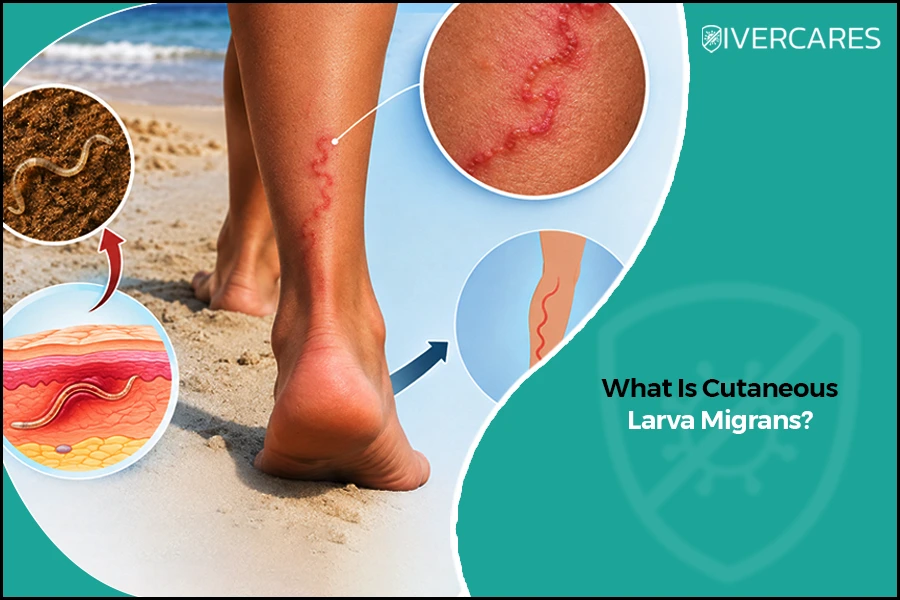
The red line isn’t the larva itself. It’s your skin reacting to it. The actual larva is usually a centimetre or two ahead of the track. Hide and seek with your own body, basically.
Doctors sometimes call it creeping eruption, which is a pretty good description, honestly. It’s not the same as a hookworm infection in humans, where the worms end up in the gut. This one stays in the skin, with larvae under the skin doing their thing.
Where you actually pick it up
Warm, sandy, damp places. Barefoot on a tropical beach. Lying on a towel on damp sand. Sitting on bare soil without a mat. Kids digging where a dog has been.
Cutaneous Larva Migrans causes come down to animal poop. Cats and dogs pass hookworm eggs, the eggs hatch in soil, and the larvae wait around in damp sand or grass. Walk through, sit down, or kick sand up your legs, and they get their chance.
Most of it is sand and soil parasite exposure, which sounds dramatic but is really just a nice day at the beach gone a bit wrong.
It’s common in the Caribbean, Central and South America, sub-Saharan Africa, parts of South and Southeast Asia, and some warm southern areas of the US. The UK sees cases too, mostly in people back from holiday.
The classic story is an itchy rash after walking barefoot on a beach, and yes, that’s the story most people I know who’ve had it tell.

How long until it shows up?
Usually within days of exposure, sometimes a bit longer. Cutaneous larva migrans symptoms often start with a small itchy bump, then a thin red or pink line begins to extend, often a centimetre or two a day.
The itching is the bad bit. It tends to get worse at night, and some people barely sleep. A few don’t itch much at all, which is unlucky, because they put off seeing a doctor.
What the line looks like
Snaky. Zigzags. Sometimes it doubles back, like a river that can’t decide where it’s going.
It’s usually on the feet, ankles or buttocks, because those touched the ground. The back and thighs are possible too, especially after lying on a towel on contaminated sand.
Most of the time, Cutaneous Larva Migrans looks obvious once you’ve seen it. That itchy winding skin rash is what people notice first, and the moving quality is what scares them. The larva migrans rash is usually what gets people to a doctor.
Who gets it, and can it spread?
Pretty much anyone who walks, sits, or lies on the wrong ground. Kids are at higher risk because they’re on the sand all day. Cuts and scratches help the larvae get in, since dry, intact skin is tougher for them.
It doesn’t spread from person to person. You can’t pass it to your partner or kid on the sofa. So when people ask how Cutaneous Larva Migrans spreads, the answer is contaminated sand or soil, not other people.
How doctors figure it out
A cutaneous larva migrans diagnosis is usually done by looking. The pattern is so typical that a GP, dermatologist, or travel doctor often recognises it straight away.
They might check a blood count, since a raised eosinophil level can point to a worm infection. Skin scrapings or biopsies are rare here. Photos taken a few days apart can help, because the line keeps moving.
The treatment bit
Cutaneous larva migrans treatment is usually prescription antiparasitic tablets, most often ivermectin or albendazole. Ivermectin often clears it within a few days, though the rash can linger for weeks after the larva is dead. Topical creams are sometimes used for small lesions, but tablets are more common.
You might come across Iverhuman 12 mg on a prescription. I went looking for it and couldn’t find reliable details, so I can’t tell you what it is or whether it’s sold where you live. If a doctor writes it down, ask them and your pharmacist to confirm the active ingredient, the dose, and how long to take it. Doses depend on your weight and the condition, so don’t guess.
Please don’t borrow Iverhuman 12 mg from someone else’s stash, even if it worked for them. That’s a bad idea, and I say that as someone who has definitely thought about it with a leftover pill.
If you just wait it out
Most cases die off on their own eventually, but eventually can mean weeks or months of itching. Antihistamines help with the itch. Cover it loosely and try not to scratch, which I know is impossible at 3 am.
The bigger risk is scratching. Broken skin can get infected, with redness, swelling, pus, or a fever. Complications of cutaneous larva migrans are mostly about that secondary infection, though rare allergic lung reactions are described with some worm infections.
Keeping it off your feet
Cutaneous Larva Migrans prevention is mostly boring common sense. If you want the practical answer on how to prevent hookworm skin infection, here’s what I’d do.
Wear shoes or sandals on tropical beaches, even if sand feels nicer on bare feet. Use a towel or mat instead of lying on damp sand. Don’t sit on damp soil with bare legs. Rinse sand off quickly, especially feet and buttocks, and cover any cuts.
If you have pets, keep them wormed. That cuts down the source, which is the whole game.
When to actually go in
If you’re wondering when to seek medical care for a skin rash, a moving line after a beach trip is a good reason to make the call. In the UK, that’s your GP, an NHS walk-in centre, or 111. In the US, a primary care doctor, urgent care, or a dermatologist.
If you also have a fever, or the area is hot, swollen, blistered or oozing, don’t wait.
What happened to my friend
He went to a travel clinic. The doctor looked at his foot, didn’t laugh, and gave him tablets, and the line stopped moving within a couple of days. The rash took a couple of weeks to fade.
He’s now the friend who packs flip-flops everywhere. He still insists it was a worm. He wasn’t wrong, exactly. It was just a very small, very lost one.
FAQs
- Is Cutaneous Larva Migrans dangerous?
Usually no, but it’s very itchy, and scratching can cause infection. Treatment works well.
- Is it contagious?
No. It comes from sand or soil, not from other people.
- How do you catch it?
Usually from bare skin touching sand or soil contaminated with animal hookworm larvae.
- How long does it last without treatment?
Often weeks, sometimes months. Treatment usually clears the larvae much faster.
- Do I need to see a doctor?
Yes, if you have a moving or spreading skin line, especially after a beach trip or walking on sand.