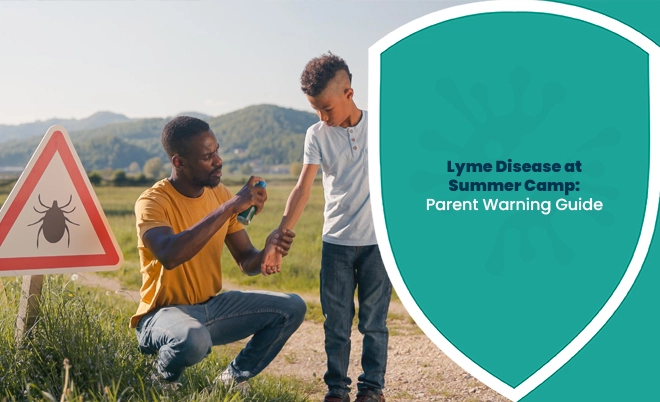
Your child creates life-long memories at summer camp. Outdoor adventures, tree climbing, hiking trails, a campfire, and outdoor games keep days full of fun. As you pack up the sun cream, the additional pair of socks, and some extra snacks, there’s one little hazard most parents tend to forget ticks.
Table of Contents
ToggleAlthough Lyme disease at summer camp might appear insignificant, it can become a problem for families of children who spend long hours outdoors and can cause this disease. Knowing what to look out for, how to prevent these issues, and their treatment can help you keep your child safe before they become serious.
This blog will make you aware of warning signs, available treatments such as Doxycin 100mg, and when to seek medical help. In 2019, a review published in the journal “Canadian Agency for Drugs and Technologies in Health” revealed the efficacy of one dose doxycycline for this disease prevention
Lyme Disease at Summer Camp: Why?
Typically, summer camps are in a wooded area, a grassy field, or close to a lake or a trail. These are great habitats for ticks.

Your child may play for hours:
- Running through tall grass,
- Hiking forest paths
- Sitting on logs
- Playing outdoor sports
- Poking around in ‘bushes’ and ‘wooded areas’
Tick bite summer camp will usually attach but won’t cause pain. They are small and can lie dormant for hours or even days. That’s how it can be possible for anyone to not realize they have been bitten by a tick until symptoms start to manifest.
What Is Lyme Disease?
This is a bacterial infection that is caused by Borrelia burgdorferi, present in the infected tick.
Not all ticks are infected, and not all tick bites lead to infection with Lyme Disease at Summer Camp. However, early detection is important because this untreated, can spread and impact multiple systems in the body.
Children can be more vulnerable because they go outdoors to play, and may not feel any ticks on their skin.
Lyme Disease Symptoms Children: Watch After Summer Camp
As your child comes back from camp, the question you may first be asked is, “Did he/she have a good time? The question you’ll likely ask yourself first as your child returns home from camp is, “Did he/she have a good time? Hearing about camp activities is important, but so is listening for potential symptoms.
Your child may have symptoms of Lyme disease, such as:
- Fever
- Chills
- Fatigue
- Headache
- Muscle aches
- Joint pain
- Swollen lymph nodes
- Neck stiffness
Several symptoms are similar to those of common viral infections, making it hard to recognize that it is Lyme disease. Don’t dismiss or shrug off symptoms if they arise after being outside.
The Famous Bull’s Eye Rash Kids: What Parents Need to Know
One of the most common symptoms is the “bull’s eye rash kids”.
This rash often:
- Starts as a little red spot
- Grows across a multiday period
- Produces a circular pattern
- May look like a target or a bull’s eye
However, there is one crucial factor that many parents overlook. Not all children have the typical bull’s eye pattern.
For some children, there may be just:
- A solid red rash
- Multiple smaller rashes
- Irritation of the skin around the bite
So, no bull’s-eye pattern doesn’t rule out the possibility of this disease.
How Will You Recognise Lyme Disease in Its Early Stages
The early symptoms of this disease typically develop in days to weeks after infection. Initial symptoms may involve:
Stage 1: Early Localized Infection
- A rash around the bite area
- Mild fever
- Fatigue
- Headaches
Stage 2: Early Disseminated Infection
Bacteria can invade the kids’ bodies if not treated. Possible symptoms are:
- Multiple skin rashes
- Facial weakness
- Joint discomfort
- Heart rhythm problems
- Nerve symptoms
Stage 3: Late Lyme Disease
This stage can occur several months after and include:
- Severe arthritis
- Ongoing fatigue
- Neurological complications
Early recognition of symptoms can greatly enhance recovery.
What Will Happen if Your Child’s Lyme Disease Goes Untreated?
Many parents think that symptoms will go away on their own. Unfortunately, if left untreated, Lyme Disease at Summer Camp can cause the following long-term effects:
- Chronic joint pain
- Memory issues
- Nerve problems
- Persistent fatigue
- Concentration difficulties
- Recurrent arthritis
If symptoms persist, children may have difficulty in school or in daily life. It is important to treat early, as it reduces the risk of complications.
How Doctors Diagnose Lyme Disease
Once your child shows signs or symptoms following camp, your doctor might ask some of these questions:
- Have they been outside?
- Has your child been to woodland areas?
- Was a tick found?
- Have you developed a rash?
This disease diagnosis test may be suggested as well. Testing usually involves blood antibody testing. In this test, doctors commonly use the ELISA test and the Western blot confirmation test. The results of tests will change depending on the timing of the infection. At very early infection, sometimes there is a normal laboratory finding even in the presence of symptoms. This is why the doctor may take into account both symptoms and exposure history.
Treatment Options: Doxycin 100mg
If this disease is diagnosed in the early stages, a course of antibiotics is often prescribed. Commonly, the choice is Doxycin 100mg, which is a drug containing doxycycline that is used to treat bacterial infections Your doctor might prescribe Doxycin 100mg under the following circumstances:
- Child’s age
- Weight
- Symptom severity
- Medical history
- Infection stage
Doxycycline for Lyme disease:
Historically, doxycycline has been avoided in children aged <8 years due to concern for permanent tooth staining. However, short courses of doxycycline <21 days were recognized to be safe for children of all ages in 2018. The frequency and trends of this disease PEP have not been described. Medical researchers evaluated patterns of single-dose doxycycline dispensings in a large patient cohort during 2010-2020.
Dosages:
Lyme Disease Condition | Age Group | Typical Doxycin (Doxycycline) Dose | Treatment Duration |
Early localized Lyme disease | Children ≥8 years | 2 mg/kg twice daily (maximum 100 mg per dose) | 10 to 21 days |
Lyme carditis (mild cases) | Children ≥8 years | 4.4 mg/kg per day divided into 2 doses | 14 to 21 days |
Lyme arthritis | Children ≥8 years | 4.4 mg/kg per day divided into 2 doses | 28 days |
Neurologic Lyme disease | Children ≥8 years | 2–4 mg/kg twice daily (maximum 200 mg per dose) | 10 to 28 days |
Post–high-risk tick exposure | Children | 4.4 mg/kg (maximum 200 mg) | One-time dose |
Important precautions while using Doxycin 100mg:
- Follow the instructions for the prescription
- Fully complete the rest of the course
- Use enough water to give:
- Avoid missing doses
- Tell your doctor if you are allergic to anything or taking any drug.
- Do not try to treat yourself.
Practical Tick Bite Prevention Kids: Summer Camp
The best defense is prevention for tick bite prevention kids. It is not possible to eliminate all risks at camp, but exposure can be greatly reduced. Kids’ strategies for tick bite prevention include:
Choose smart dress like Long sleeves, Long pants, Closed shoes, and Light-colored clothing. Ticks are more visible in lighter colored areas.
You may apply proper insect repellents. You need to use repellents as directed and recommended by age. You do a tick to check each day, such as behind the ears, under the arms, around the waist, Scalp, Neck, and between toes.
Your kids can take a shower after getting outside. Because bathing can be done to remove unattached ticks. You should teach your child about awareness. If your child notifies camp staff immediately, they should let them know if any of the following occur:
- They find a tick
- Notice a rash
- Feel unusual symptoms
What You Should Do if You Find a Tick?
When you find a tick, it can be frightening, but it can be dealt with promptly. Steps to follow to reduce Lyme disease long term effects:
- Use fine-tipped tweezers.
- Pick up the tick as close to the skin as possible.
- Pull slowly and steadily up.
- Avoid twisting or crushing it.
- Clean up following.
Check your child for symptoms over the next few weeks.
Final Thoughts
Friendship, adventure, and laughter should be the first things that come to mind when you think about summer camp, not routine or common health issues.
Your awareness is your best protection as a parent! Be aware of the early signs, know the risks of Lyme Disease at Summer Camp, and respond promptly if symptoms occur.
Awareness of the symptoms of this disease in children, knowledge about the testing process for this disease, and information about treatment options such as doxycin 100mg will enable you to make the right choices.
Some small preparation today can lead to a happy summer tomorrow.
FAQs
- What will I do when Lyme disease symptoms develop after a tick bite?
It can take days to weeks after a tick bite for symptoms to appear.
- Will all ticks transmit Lyme disease?
No. Only a small number of ticks are infected with this disease, and not all ticks that bite are infected.
- Is it always possible to develop a bull’s-eye rash in children?
No. Some children will have different patterns of rash, or not have a rash that is obvious to them.
- What is the treatment for Lyme disease using Doxycin 100mg?
Depending on the medical evaluation by the doctor, Doxycin 100mg can be a part of the treatment.
- Will Lyme disease cause complications in the long-term?
Yes. If the condition of this disease is left untreated, it can result in fatigue, neurological problems, and continued health issues, as well as joint problems.