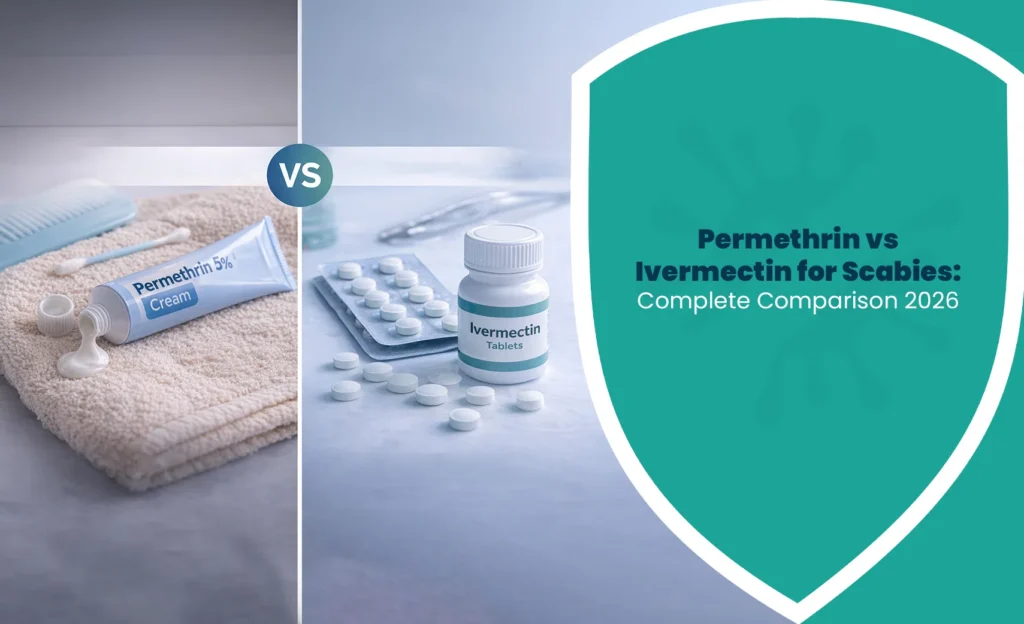
You don’t plan on learning the difference between scabies treatments. It just… happens.
Table of Contents
ToggleAn itch shows up. Then another. Then nights get longer. Someone finally says the word scabies out loud, and suddenly you’re deep in a comparison you never wanted to make – permethrin versus ivermectin – trying to understand why something that sounded “easily treatable” is still very much ruining your sleep.
I’ve covered health long enough to notice a pattern. People don’t struggle with scabies because medicine doesn’t work. They struggle because the process is messier than the pamphlet suggests.
And in 2026, that confusion hasn’t gone away.
Scabies Treatment in 2026: What Has Actually Changed – and What Hasn’t
Permethrin is still widely recommended as first-line treatment. Ivermectin is still often introduced later. That hierarchy exists in guidelines, but real-world treatment has drifted from those neat boxes.
Doctors now see more persistent symptoms. More reinfestation. More cases where the “standard” approach technically worked – but didn’t fully resolve the problem.
What’s changed isn’t the biology of scabies. It’s how clinicians think about adherence, exposure, and human error.
And that’s why this comparison still matters.
Permethrin Cream: Effective, Familiar, and Easier to Get Wrong Than People Admit
Permethrin works by killing mites on contact. You apply it carefully, leave it on for hours, then wash it off. On paper, it’s straightforward.
In reality, it’s surprisingly fragile as a system.
People miss areas. Hands get washed. Cream rubs off. Someone forgets to repeat the dose. Another person treats themselves but not their partner. None of this is malicious. It’s just normal life interfering with medical instructions.
When permethrin works, it works very well. When it doesn’t, the failure is usually logistical, not pharmaceutical.
That nuance is important, because it’s often lost when people start Googling alternatives in frustration.
Common Mistakes People Make When Treating Scabies
This is where many cases quietly unravel.
Scabies treatment requires coordination. Everyone in close contact needs treatment at the same time. Bedding and clothing have to be managed within a narrow window. One missed step can make it feel like nothing worked.
I’ve spoken to clinicians who say they see more “treatment failure” from incomplete household coverage than from actual resistance.
Which brings us to oral medication.
Ivermectin Enters the Conversation (and Why It Feels Different)
Ivermectin approaches scabies from a completely different angle. Instead of targeting mites on the skin, it works systemically. That alone changes the experience.
There’s no guessing whether you covered your back properly. No worrying about washing hands too soon. Compliance becomes simpler.
That’s why medications like Iveroot 12 mg are often considered when topical treatment hasn’t delivered the expected relief.
Not because permethrin is weak – but because oral treatment removes many human variables.
Is Oral or Cream Treatment Better for Scabies? What Doctors Actually Say
If you ask clinicians this question directly, most won’t give you a clean winner.
They’ll ask questions instead.
Can the patient apply cream properly?
Are there multiple people involved?
Is the infestation widespread?
Has adherence been an issue before?
Permethrin remains an excellent option when used correctly. Oral treatment becomes appealing when those conditions aren’t ideal.
In more persistent cases, Iveroot 12 mg may be introduced as part of a structured plan rather than a last-ditch effort.
That shift – using ivermectin earlier in select cases – is one of the quiet trends shaping scabies care right now.
Ivermectin Dosage for Scabies: What Most People Get Wrong
Here’s a critical detail many patients never hear clearly: scabies treatment is tied to the mite life cycle.
Eggs hatch days after initial treatment. That’s why repeat dosing is sometimes necessary. Not because the medication “failed,” but because timing matters.
When oral medication is used, clinicians often schedule doses deliberately to catch newly hatched mites. Iveroot 12 mg is prescribed with this timing in mind, not randomly.
Skipping doses, doubling up, or improvising schedules tends to create confusion rather than clarity.
Post-Scabies Itching: Why Symptoms Can Continue After Treatment
This is the moment most people panic.
The mites are gone – but the itching stays.
Post-treatment itch is an immune response, not an infestation. Your skin is reacting to debris left behind, and that reaction can last weeks. Sometimes longer.
I’ve interviewed patients who took Iveroot 12 mg, saw improvement, and still felt itchy enough to doubt everything.
Itching alone is not proof of failure. Unfortunately, it feels exactly like it is.
Can You Get Scabies Again From the Same Parasites or Environment?
Yes – and this is where reinfestation muddies everything.
Scabies spreads through close contact. Not dirt. Not poor hygiene. Just proximity.
If everyone wasn’t treated at the same time, or if exposure continued during treatment, symptoms can return. That return looks identical to resistance, even when it isn’t.
This is why clinicians stress synchronized treatment and environmental control alongside medication – especially when oral therapy like Iveroot 12 mg is involved.
Scabies vs Eczema: How to Tell the Difference on Real Skin
Not every lingering rash is scabies.
Treatment itself can irritate the skin. Overwashing can damage the barrier. Stress can trigger flares. Eczema and contact dermatitis are common impostors.
I once heard a dermatologist say, “Sometimes the mites are gone, but the skin hasn’t forgiven you yet.”
That line stuck with me because it explains so many prolonged cases.
Escalating treatment without reassessment can prolong symptoms rather than fix them.
Why Self-Treating Parasites Can Make Infections Harder to Clear
There’s a temptation to keep treating out of fear. Another round. Another product. Another late-night decision.
But overtreatment can inflame skin, confuse symptoms, and delay healing. At some point, the goal shifts from killing mites to repairing damage.
That’s why clinicians caution against reflexively repeating oral medication like Iveroot 12 mg without a clear plan.
More treatment isn’t always better treatment.
Why Ivermectin Sometimes Feels Like a “Stronger” Solution
There’s also a psychological component worth acknowledging.
Taking a pill feels decisive. Clean. Final.
For some patients, Iveroot 12 mg provides mental relief as much as physical improvement.
That matters. Stress worsens itching. Confidence helps recovery. Treatment isn’t just biological – it’s behavioral.
Final Thoughts: Choosing Between Permethrin and Ivermectin in 2026
This isn’t a battle between old and new medicine.
Permethrin still works. Ivermectin works differently. In some cases, they work best together.
The mistake is assuming persistence equals failure, or that switching treatments automatically solves everything.
The smarter thing to do is to figure out why a treatment was chosen and what else needs to happen with it.
If you use them wisely, drugs like Iveroot 12 mg can help you, not hurt you.
Healing from scabies is rarely instant. But it is achievable. And with the right plan, it doesn’t have to feel endless.
FAQs
1. Why does permethrin work for some people but not for others?
A lot of it comes down to how it’s used, not whether it’s “good” or “bad.” Permethrin depends heavily on perfect application – covering every area, leaving it on long enough, repeating it at the right time, and treating close contacts together. Miss one step and it can feel like the treatment failed, even though the medication itself is effective. In real life, people are busy, distracted, and human – and scabies doesn’t forgive small gaps.
2. Does needing ivermectin mean my scabies was severe or resistant?
Not necessarily. In many cases, oral treatment is chosen because it’s simpler, not stronger. It removes a lot of guesswork around application and compliance. When topical treatment isn’t possible, when more than one person is involved, or when symptoms haven’t gotten better, doctors may suggest it. It’s often a planned choice, not a sign that something is very wrong.
3. Why am I still itching if the mites are supposed to be gone?
This is one of the most confusing parts of scabies treatment. Even after mites are eliminated, your immune system can stay activated for weeks. The skin has essentially been under attack, and it doesn’t calm down overnight. That lingering itch feels exactly like active scabies, which is why so many people panic – but itching alone doesn’t mean treatment failed.
4. Is it better to switch treatments quickly if the first one doesn’t seem to work?
Usually, no. Switching too fast can actually make things harder to interpret. Sometimes what looks like failure is just slow healing or post-treatment irritation. Doctors typically want to see how symptoms evolve over time before changing course, unless there are clear signs the infestation is still active. Patience here is uncomfortable – but often necessary.
5. How do I know when it’s time to go back to the doctor instead of waiting it out?
If symptoms aren’t improving at all after a few weeks, if new rashes or burrows keep appearing, or if the itching is seriously affecting your sleep or mental health, that’s a good moment to check in again. Not because you’ve done anything wrong – but because clarity matters. Sometimes reassurance is the treatment. Other times, a plan adjustment is needed.