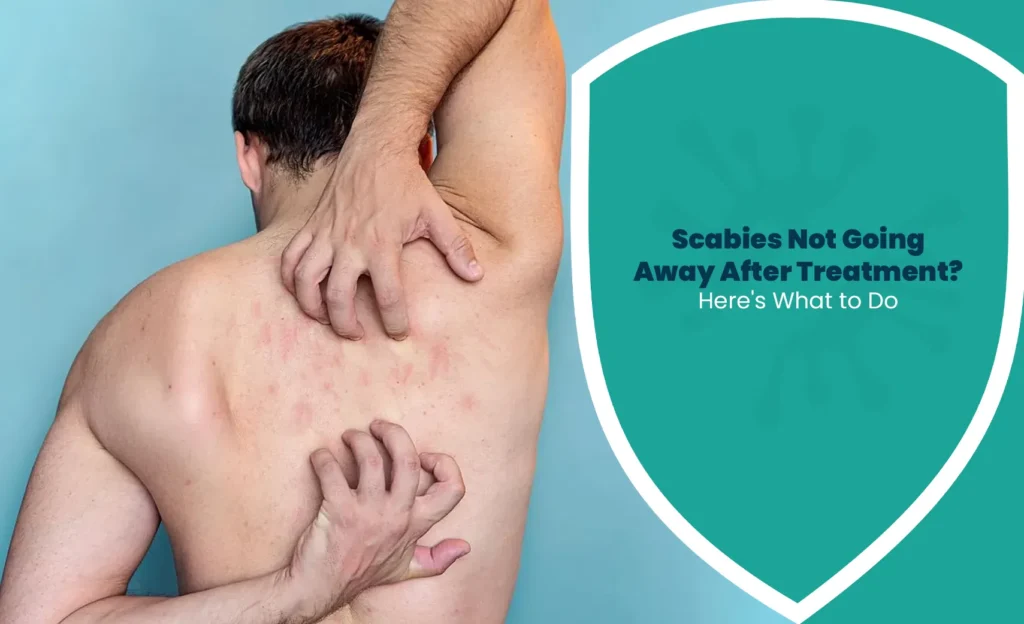
Scabies has a way of sneaking into your life quietly and then overstaying its welcome.
Table of Contents
ToggleAt first, it feels manageable. A rash that itches. Nights that feel a little longer than usual. A doctor’s visit, a prescription, a firm belief that this will all be over soon. Most people expect scabies to be a one-and-done problem.
And then it isn’t.
Days pass. Sometimes weeks. The itching fades… then flares again. Your skin looks calmer one morning and angrier the next. You start questioning every sensation. Is this healing? Or is it back?
I’ve spoken to people who said the physical symptoms were annoying – but the mental part was exhausting. The second-guessing. The fear of reinfecting loved ones. The quiet dread of bedtime, when itching always seems louder.
If scabies hasn’t cleared after treatment, you’re not alone. And more importantly, you’re not automatically “doing something wrong.”
Scabies: Causes, Symptoms, and Why Treatment Sometimes Fails
Scabies is caused by microscopic mites burrowing into the skin. That part is well known. What’s less discussed is how unpredictable the body’s reaction can be – both during and after treatment.
Some people respond quickly. Others don’t.
Treatment failure isn’t always about resistance or incorrect medication. Often, it’s something smaller and more human: missed areas during application, washing treatment off too soon, or treating only one person in a household when everyone needed treatment at the same time.
Doctors see this constantly. Not because patients are careless – but because scabies treatment is surprisingly easy to mess up without realizing it.
In more persistent cases, oral therapy may be introduced alongside or instead of creams. That’s where medications like Iverjohn 3 mg enter the conversation for certain patients.
But medication alone is rarely the whole story.
Post-Scabies Itching: Why Symptoms Can Linger Even After Treatment
Here’s a truth many people aren’t told upfront:
Itching doesn’t stop the moment scabies mites die.
What you’re often feeling afterward is your immune system calming down. The body reacts not just to live mites, but to their remains – eggs, debris, waste – left behind in the skin.
This reaction can last weeks.
Sometimes longer.
Dermatologists call this post-scabetic itch, and it’s one of the biggest reasons people believe treatment didn’t work when it actually did. The skin remembers the trauma, even after the infestation is gone.
That lingering itch can look and feel identical to active scabies. Same places. Same nighttime intensity. Same panic.
And yes, it can drive you slightly mad.
Common Mistakes People Make When Treating Scabies
If scabies truly hasn’t cleared, the cause is often practical rather than pharmaceutical.
Missed skin folds. Under fingernails. Behind knees. The soles of feet. In some cases, the scalp. One overlooked area can be enough for mites to survive.
Another common issue? Reinfection.
Treating yourself but not your partner. Or your kids. Or the roommate who “doesn’t have symptoms.” Scabies doesn’t wait for symptoms to show up before spreading.
Environmental factors matter too. Clothing worn close to the skin. Towels. Bedding. Skip one item, and you may unknowingly reset the cycle.
When oral treatment such as Iverjohn 3 mg is prescribed, doctors are often trying to simplify this process – treating the whole body systemically when topical approaches haven’t been enough.
Still, success depends on timing, coordination, and follow-through.
Oral vs Cream Treatment for Scabies: Which One Works Better?
I get this question a lot, and the answer is not very satisfying but honest: it depends.
When used correctly, topical creams work well for a lot of people. Oral treatment is often reserved for stubborn cases, widespread infestation, outbreaks, or situations where applying cream thoroughly is difficult.
Neither option is “stronger” by default. They work differently.
In persistent cases, clinicians may use both. Oral medication like Iverjohn 3 mg can help address mites that topical treatment missed, especially when compliance or coverage was imperfect.
But escalation doesn’t mean failure. It just means the strategy changed.
Can You Get Scabies Again From the Same Environment?
Unfortunately, yes.
Scabies doesn’t care how clean your house is. This isn’t about hygiene. It’s about proximity and timing.
If household members weren’t treated simultaneously, reinfestation is possible. If bedding or clothing wasn’t handled properly during the treatment window, mites may survive long enough to cause problems again.
That’s why doctors emphasize treating everyone at once – even people who feel fine.
And why repeated treatment doesn’t always mean resistance. Sometimes it means exposure never stopped.
Scabies or Something Else? Conditions That Look Similar on the Skin
This is where things get tricky.
Not every post-treatment rash is scabies. In fact, many aren’t.
Treatment itself can irritate the skin. So can over-washing. So can stress. Eczema flares, allergic dermatitis, bacterial infections from scratching – all can mimic scabies closely.
I once interviewed a dermatologist who said, “Half the people convinced they still have scabies actually have skin that’s exhausted.”
That doesn’t make your symptoms imaginary. It just means the diagnosis deserves another look.
Why Persistent Skin Infections Affect Sleep, Stress, and Mental Health
There’s a psychological toll to scabies that doesn’t get enough attention.
Constant itching disrupts sleep. Poor sleep increases anxiety. Anxiety heightens skin sensitivity. It’s a loop that feeds itself.
People become hyper-aware of every sensation. A tickle becomes a threat. A red spot becomes proof.
I’ve seen patients spiral not because scabies was severe – but because it wouldn’t end cleanly.
That mental exhaustion matters. Healing skin requires calm nerves as much as medication.
Ivermectin Dosage for Scabies: What Most People Don’t Realize
When oral medication is used, timing matters as much as dose.
Scabies mites have a life cycle. Eggs hatch days after treatment. That’s why repeat dosing is sometimes necessary – not because the first dose “failed,” but because biology demands a second pass.
Doctors may prescribe Iverjohn 3 mg in carefully timed intervals based on weight, severity, and exposure risk.
Skipping doses, doubling doses, or self-adjusting schedules can make symptoms worse – not better.
When More Treatment Makes Scabies Symptoms Worse
This is the part nobody wants to hear.
More is not always better.
Overtreating can inflame skin, prolong itching, and make it nearly impossible to tell whether mites are present or the skin is simply reacting to irritation.
At some point, treatment shifts from killing mites to healing skin.
That transition is uncomfortable – but necessary.
How to Know If Scabies Is Gone or Still Active
There’s no perfect home test.
Improving symptoms, even slowly, are a good sign. New burrows or spreading lesions are not. If weeks pass with no improvement at all, reassessment matters.
Sometimes doctors repeat treatment. Sometimes they don’t.
In certain persistent cases, Iverjohn 3 mg may be used again as part of a structured plan, not a panic response.
Context is everything.
Can Scabies Spread Through Everyday Objects?
Briefly – yes.
Mites don’t live long off the body, but clothing and bedding worn close to the skin can carry them for a short time. That’s why laundering during treatment matters.
This doesn’t mean your house is contaminated forever. It means timing matters.
Miss the window, and reinfestation becomes possible.
Scabies Treatment in 2026: What Has Actually Changed?
Not much – and that’s the point.
Scabies is ancient. The treatments are established. What’s evolved is understanding – of reinfestation, post-treatment symptoms, and mental health impact.
Medications like Iverjohn 3 mg remain tools, not miracles.
They work best when paired with patience, coordination, and good guidance.
The Part Nobody Says Out Loud
You’re allowed to be tired of this.
You’re allowed to want it over. You’re allowed to ask for a second opinion.
Scabies not going away doesn’t mean you’re broken. It means biology is messy, skin heals slowly, and parasites don’t follow neat timelines.
In difficult cases, doctors may try oral treatments like Iverjohn 3 mg again along with controlling the environment and managing symptoms.
And sometimes, the best thing to do is stop so that the skin can heal, the nervous system can calm down, and the fear can let go.
The Takeaway Most People Need to Hear
Scabies persistence doesn’t equal failure.
It means complexity.
If you’re still struggling, seek reassessment. Ask questions. Don’t self-treat endlessly out of fear.
When used thoughtfully, treatments – including Iverjohn 3 mg – can be effective.
Healing just doesn’t always look the way we expect.
And no, this doesn’t last forever – even when it feels like it might.
FAQs
1. Why am I still itching even after scabies treatment? Did it not work?
This is probably the most common – and most distressing – question people ask. In many cases, ongoing itching doesn’t mean the mites are still alive. It’s often your immune system reacting to what they left behind. Think of it like smoke after a fire. The fire’s out, but the smell lingers. For some people, that reaction can last a few weeks, especially if the skin is sensitive or already inflamed. It’s frustrating, but it doesn’t automatically mean treatment failed.
2. How can I tell the difference between post-scabies itch and active scabies?
Honestly, even doctors don’t always know right away. Post-scabies itch usually improves slowly over time, even if it comes and goes. Active scabies tends to spread, worsen, or show new burrows and bumps in fresh areas. If nothing has changed – or things are getting worse – after a few weeks, that’s usually a sign you need a reassessment rather than more guesswork at home.
3. Is it possible I got scabies again instead of the treatment failing?
Yes, and this happens more often than people admit. Scabies spreads through close contact, not dirt or poor hygiene. If household members, partners, or close contacts weren’t treated at the same time, reinfestation is possible. The tricky part is that it feels exactly like treatment failure, even when the medication actually worked the first time.
4. Can over-treating scabies make symptoms last longer?
Yes, surprisingly. If you get treatments too close together, they can make your skin itch and keep the cycle going. At some point, the issue isn’t mites; it’s skin that is angry and has had too much treatment. That’s why doctors sometimes tell people to stop getting active treatment and instead focus on calming and healing the skin. It feels counterintuitive, but in many cases, less really is more.
5. When should I stop waiting it out and see a doctor again?
It’s time to see a doctor if your symptoms haven’t gotten any better after a few weeks, if new rashes or burrows keep showing up, or if the itching is making it hard for you to sleep or think clearly. Not because something terrible is happening – but because you deserve clarity. A reassessment can confirm whether scabies is still present or if something else is driving the symptoms now.