If you’ve ever woken up scratching like crazy, staring at mysterious bumps on your skin and wondering, “Oh god… what bit me?”, you’re definitely not alone. Skin rashes that show up out of nowhere can be unsettling. And when the internet throws terms like scabies and bed bugs at you, the panic gets real pretty fast.
Here’s the thing though: even though both conditions involve itching, red bumps, and an unwanted critter situation, they’re very different problems. Different causes, different treatments, different levels of urgency.
And yet… their rashes can look confusingly alike. Interestingly, many people end up mistaking scabies for eczema, and vice versa. There’s a full comparison in Scabies vs. Eczema: Spotting the Difference, but for now let’s stay on track.
So… What Actually Causes Each Rash?
Scabies happens when microscopic mites burrow into the skin. They literally dig tiny tunnels, yes, burrows, under the outer layer. Sounds weird, right? These burrows are often the biggest giveaway. There’s a whole explainer on dosage and treatment in Ivermectin Dosage for Scabies: 9 Facts You Must Know, if you’re curious about how doctors typically approach severe cases.
Bed bugs, on the other hand, don’t live on or inside your skin. They just feed on it. They come out at night, bite exposed areas, and return to hiding.

Even though both involve “bugs,” scabies mites behave more like invisible houseguests who never leave, while bed bugs are more like opportunistic nighttime visitors.
Let’s Talk Rash Appearance (Because That’s Where Confusion Starts)
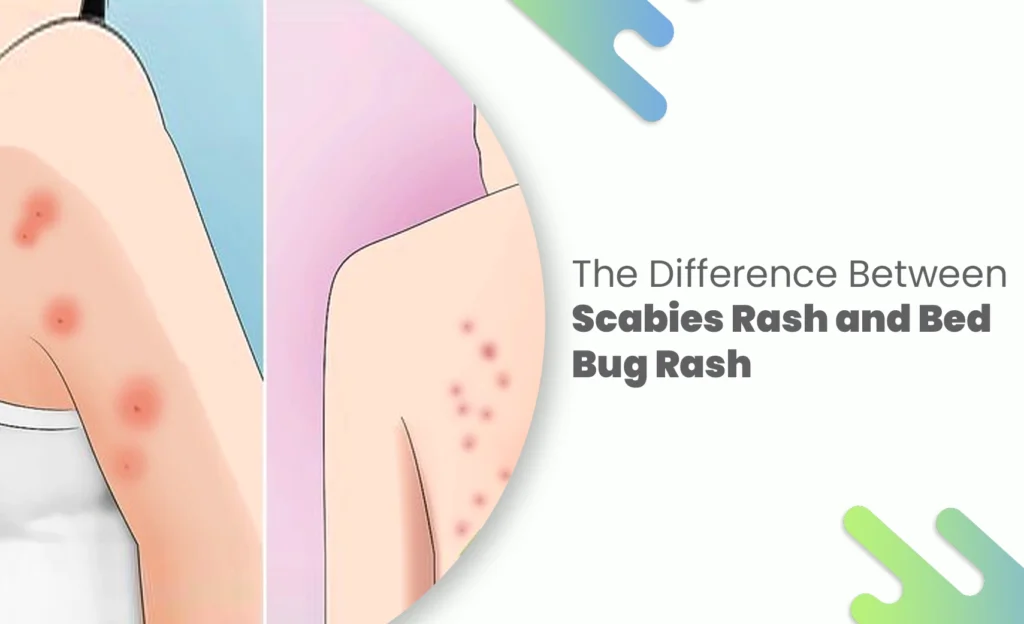
To be honest, scabies and bed bug bites can look surprisingly similar to the untrained eye. But there are differences hiding in the details.
Scabies Rash
- Small red bumps
- Thin thread-like burrows (like someone drew faint pencil marks)
- Often found in warm, hidden areas: finger webs, wrists, waistline, groin, nipples
A lot of people panic when they see itchy bumps without a rash, but that’s not always scabies. There’s a helpful breakdown in Causes of Itchy Skin Without Rash if someone is dealing with unexplained itching.
Bed Bug Rash
- Red bumps grouped in clusters or in a straight line pattern
- Appears on exposed skin: arms, legs, back, neck
- Usually shows up the morning after sleeping
Those neat bite lines? Scabies almost never creates that kind of pattern.
The Itching: What It Feels Like (And Why It Matters)
You might be wondering, Isn’t all itching the same?
Not quite.
Scabies Itching
Let’s be real, scabies itching is intense. People describe it as a deep, relentless itch that steals their sleep. Nighttime makes it worse because the mites are more active.
Misdiagnosis is extremely common. Many people try home methods, some helpful, many not. A more structured breakdown is available in Can You Treat Scabies at Home?, which goes into what actually works and what doesn’t.
Bed Bug Itching
Irritating? Definitely.
Unbearable? Usually not.
Bed bug bites can itch a lot, but they rarely have the same “can’t sleep, can’t think” intensity as scabies.
Timing: How Fast Do the Rashes Appear?
Scabies has a slow burn.
The first time someone gets infected, it may take 2 to 6 weeks before the rash shows up.
Bed bug bites?
You often notice them overnight.
So if the rash appeared suddenly after sleep, bed bugs climb higher on the list.
A Real-Life Scenario: Because Theory Isn’t Always Enough
A surprising number of people treat themselves for the wrong condition simply based on Google images. Some even jump straight into antiparasitic medicines like Ivermectol 12 mg without knowing what they’re dealing with, something dermatologists warn strongly against.
A better starting point is ruling out environmental triggers. Many readers find Common Household Habits That Spread Infections useful because it highlights how easily bugs, mites, and microbes move through daily routines.
Contagious or Not? This Is Where the Biggest Difference Lies
Here’s the thing:
Bed bugs are not contagious.
You don’t “catch” them from someone. You get bitten because the bugs are in your environment.
Scabies, however, spreads through skin-to-skin contact.
Sharing towels, sleeping in the same bed, hugging, or even extended hand-holding in some cases can transmit it.
Because of this, treatments like Ivermectol 12 mg (used under medical guidance) are sometimes prescribed when scabies infestations become severe or widespread.
People often wonder if pets can bring scabies into the home. That’s covered in Can You Get Scabies From Cats?, which clears up a lot of common confusion.
Burrows Versus Bite Marks
This one is huge.
Burrows = scabies.
Bite lines = bed bugs.
Burrows look like faint, short, zig-zag lines. They’re one of the most characteristic signs of scabies, yet they’re also one of the most overlooked.
Where the Rashes Show Up
Scabies prefers:
- Folds of skin
- Finger webs
- Elbows
- Waist and abdomen
- Buttocks
- Genitals
Bed bugs prefer:
- Shoulders
- Arms
- Legs
- Back
- Neck
Basically, wherever your skin is bare while you sleep.
Misdiagnosis Happens More Than You’d Think
It’s not as simple as it looks.
People often confuse scabies with contact dermatitis, eczema, allergies, or even lice-related rashes. Crusted scabies, especially, can be misleading.
And because scabies is often mishandled at first, Common Mistakes People Make When Treating Scabies is a genuinely useful companion read. It explains why certain “quick fixes” make things worse.
Treatment: Where These Two Problems Completely Split Paths
Scabies
Requires medical treatment.
Doctors may prescribe permethrin cream or oral antiparasitic medication. In some cases, especially when topical therapy isn’t enough they may recommend Ivermectol 12 mg.
But taking Ivermectol 12 mg without diagnosis won’t help if the issue isn’t scabies. Using it incorrectly can also delay recovery, which is why medical guidance is so important.
Bed Bugs
No medicine can “cure” bed bug bites because the bugs aren’t living on your skin.
You have to remove them from your environment with high heat washing, vacuuming, sealing cracks, and often professional pest control.
This is why people who take Ivermectol 12 mg for bed bug bites see no improvement; the medicine isn’t designed for that problem at all.
What People Overlook: Environment vs. Body
One interesting side note:
Sometimes people think their rash keeps coming back because the medicine “didn’t work.” In reality, the environment is the culprit either the mites weren’t fully eliminated or the bed bugs were never addressed.
If someone wants more clarity on environmental triggers, Common Household Habits That Spread Infections adds a good layer of awareness.
When To Seek Medical Help
You should contact a doctor if:
- The itching becomes unbearable
- You notice burrows
- More than one person in your home develops symptoms
- The rash spreads rapidly
- Over-the-counter creams don’t help
Doctors will decide whether topical medication or something like Ivermectol 12 mg is appropriate.
Final Thoughts
Skin rashes can feel stressful because they’re so visible and so uncomfortable. But the good news? Both scabies and bed bug rashes are treatable just with very different approaches.
If the rash has burrows, spreads easily, and keeps you awake at night, scabies becomes more likely.
If the bites come in straight lines and appear overnight, bed bugs rise to the top of the list.
Either way, getting the right diagnosis matters way more than guessing and definitely more than self-medicating.
FAQs
1. How do I know if my rash is from scabies or bed bugs?
It mostly comes down to pattern and location. Scabies causes burrows and intense nighttime itching, usually in warm skin folds like between the fingers or around the waist. Bed bug bites, on the other hand, tend to appear in straight lines or clusters on exposed areas like arms, legs, or the neck usually showing up overnight. If the rash forms zig-zag bite marks, bed bugs are more likely.
2. Can scabies go away on its own?
To be honest, no. Scabies won’t disappear without proper treatment. The mites keep reproducing under the skin until you use medicated creams or, in some cases, doctor-prescribed oral treatments. Leaving it untreated can also spread it to others, so it’s better to address it early.
3. Do bed bugs live on the skin like scabies mites?
Not at all. Bed bugs don’t live on you, they live around you. They hide in mattresses, furniture, cracks, or fabric seams and only come out to feed at night. Scabies mites burrow inside the top layers of your skin and stay there until treated, which is why the itching feels more constant and intense.
4. Is it possible to have both scabies and bed bugs at the same time?
Surprisingly, yes. It’s rare, but it can happen especially in crowded living situations, hostels, shared apartments, or during travel. If a rash behaves unpredictably (for example, burrows and bite lines), getting a professional diagnosis becomes really important.
5. Should I take medication like Ivermectol 12 mg if I’m not sure what’s causing my rash?
It’s better not to. Taking medicines meant for scabies won’t help with bed bug bites and might mask symptoms temporarily, making diagnosis harder. The best move is to get a proper consultation once you know what’s actually causing the rash, treatment becomes much easier and faster.
References
- https://www.ncbi.nlm.nih.gov/books/NBK544306/
- https://www.patientcareonline.com/view/bed-bug-bites-everything-you-need-know-were-afraid-ask#:~:text=completely%20different%20story.-,Diagnosis%20and%20treatment,Practice%20message%20and%20future%20directions
- https://doi.org/10.1371/journal.pntd.0007182
- https://doi.org/10.5114/ada.2021.106194